

Crypto Miner Comparison 2026 — The best ASICs and GPUs for Altcoins (without Bitcoin)
When people say "crypto mining," they often automatically mean Bitcoin. However, in 2026, there's a vibrant scene of altcoin mining hardware beyond SHA-256. From Kaspa ASICs to Alephium boards and classic Ravencoin GPUs — this comparison shows the best crypto miners for altcoins, sorted by coin, efficiency, and acquisition costs. If you're looking for a Bitcoin miner, the Bitcoin Miner Buying Guide is the right article — this one is about everything else.
Why mine Altcoins instead of Bitcoin?
In 2026, Bitcoin mining is almost exclusively economical in the industrial sector. For private individuals with normal household electricity, altcoins are more interesting in three scenarios:
- Lower Network Difficulty. For younger or less popular coins, there is less total hashrate in the network, so even small miners have a realistic share of the block rewards.
- Better Energy Efficiency per Dollar. Some altcoin algorithms (kHeavyHash, Blake3, RandomX) have been optimized less than SHA-256, so GPU or older ASIC hardware still offers opportunities.
- Diversification. Mining multiple coins spreads the price risk — and often retains the ability to spontaneously switch to the most profitable coin.
Important: "More profitable than Bitcoin" does not automatically mean "profitable." With German electricity prices, many altcoin miners are also operating at a loss. The calculation must always be made individually.
The most important Mining Algorithms 2026
| Algorithm | Most Important Coins | Ideal Hardware |
|---|---|---|
| SHA-256 | Bitcoin, Bitcoin Cash | Antminer, Whatsminer (ASIC) |
| kHeavyHash | Kaspa | Bitmain KS3/KS5L, IceRiver KS |
| Blake3 / POW3 | Alephium | Goldshell AL-Box |
| Scrypt | Litecoin, Dogecoin | Antminer L7/L9 (Merge-Mining) |
| Ethash / Kawpow | Ravencoin, ETC | Nvidia RTX 3070/4070 Ti, AMD RX 6800 |
| RandomX | Monero | AMD Ryzen 9 CPUs |
| Blake2b-Sia | Siacoin | Goldshell SC-Box |
Top Pick Kaspa: The big Altcoin Story 2024-2026
Since 2023, Kaspa has developed into the most interesting altcoin mining option. The BlockDAG-based coin processes 10 blocks per second and uses the kHeavyHash algorithm, for which specialized ASICs are available. The leading models:
- Bitmain Antminer KS5L — 21 TH/s, 3,150 W, approx. €5,500-€7,000, currently the most efficient Kaspa device
- Bitmain Antminer KS3 — 8.3 TH/s, 3,188 W, €2,500-€3,500, for smaller setups
- IceRiver KS3L — 9 TH/s, 3,400 W, €2,800-€3,500, cheaper alternative with a slightly worse J/TH ratio
- IceRiver KS0 (Home Variant) — 100 GH/s, 65 W, €350-€500, the only somewhat living-room-friendly Kaspa option
Profitability: In 2026, Kaspa mining is the only segment where German household electricity prices for smaller devices (IceRiver KS0) still come close to break-even. For larger devices, the same rules apply as for Bitcoin: profitable only with industrial electricity.
Alephium — the Blake3 Underdog
Alephium is a younger coin with its own Proof-of-Less-Work mechanism (a variant of Proof of Work with lower energy consumption). The leading miners:
- Goldshell AL-Box — 500 GH/s, 300 W, approx. €800-€1,200, desktop-suitable
- Goldshell AL3 Pro — 1.5 TH/s, 900 W, approx. €2,500-€3,500
- Eichhörnchen-Miner (DIY) — Community-FPGA-Builds, experimental
Interesting: Due to its Blake3 variant and lower network hashrate, Alephium mining often has a better return per watt than Bitcoin, even with private electricity prices.
Litecoin / Dogecoin with Scrypt — the Merge Mining Wonder
Scrypt mining has a decisive advantage: You mine two coins simultaneously. Through merge mining with Litecoin, you get Dogecoin rewards "for free" on top. The Antminer L7 and L9 are the flagships here:
- Antminer L7 — 9.5 GH/s, 3,425 W, approx. €2,500-€4,000, on the market since 2022
- Antminer L9 — 17 GH/s, 3,360 W, approx. €8,000-€12,000, the current flagship machine
The charm: You get both LTC and DOGE rewards for 24-hour operation, which typically increases the total return by 15-25% compared to pure LTC mining. Nevertheless, with German electricity prices, the known limitations apply — only profitable with industrial electricity.
Ravencoin and Ergo — the GPU Classics
Ravencoin (with Kawpow algorithm) and Ergo (Autolykos v2) are the last remaining major coins where GPU mining still makes economic sense. Hardware options:
- Nvidia RTX 3070 Ti — ~28 MH/s Kawpow, ~200 W, approx. €450-€550 used
- Nvidia RTX 4070 Ti Super — ~35 MH/s Kawpow, ~250 W, €800-€900 new
- AMD RX 6800 XT — ~45 MH/s Kawpow, ~280 W, €500-€650 used
- Nvidia RTX 4090 — ~60 MH/s Kawpow, ~400 W, €1,800-€2,200 new
The advantage of GPU mining: If crypto returns are bad, you can use the same hardware to play video games, render videos, or train machine learning models. No other crypto miner is so flexibly reusable.
Monero — the CPU Mining Example
Monero uses the RandomX algorithm, which was explicitly designed to make ASICs useless. Here, modern CPUs win, especially AMD Ryzen models with large L3 cache:
- AMD Ryzen 9 7950X — ~24 kH/s, ~170 W, €550-€650 CPU
- AMD Ryzen 9 9950X — ~28 kH/s, ~200 W, €700-€800 CPU
- AMD Ryzen Threadripper 7970X — ~55 kH/s, ~350 W, €2,800+ CPU (plus motherboard)
Monero mining is ideologically interesting: The community actively relies on decentralized, home-computer-friendly mining hardware. Economically, however, it remains a niche phenomenon.
Siacoin and other Niche Coins
Coins like Siacoin (with Blake2b), Handshake, Flux, or Epic Cash each have their own algorithms and corresponding mini-ASIC manufacturers (Goldshell is a leader here). All these niche coins have one thing in common: They are bets on future price development, not on stable returns.
What all Altcoin Miners have in common
Regardless of coin and algorithm, a few universal rules apply to altcoin mining in 2026:
- Electricity price is the critical factor. No matter how efficient the miner, at €0.32/kWh, almost every device is operating at a loss.
- Difficulty is constantly increasing. If a coin becomes profitable, new miners flock to the network and reduce returns. Early adopters often have the best chances.
- Coin price determines everything. A 20% price drop can turn a profitable miner into an uneconomical one — and vice versa.
- Merge mining or multi-algo can stabilize returns if a coin falters.
- Wallet setup and pool selection are often more complicated than for Bitcoin. Each coin has its own wallets, its own pools, its own configuration formats.
Bitcoin Mining as an Entry Point
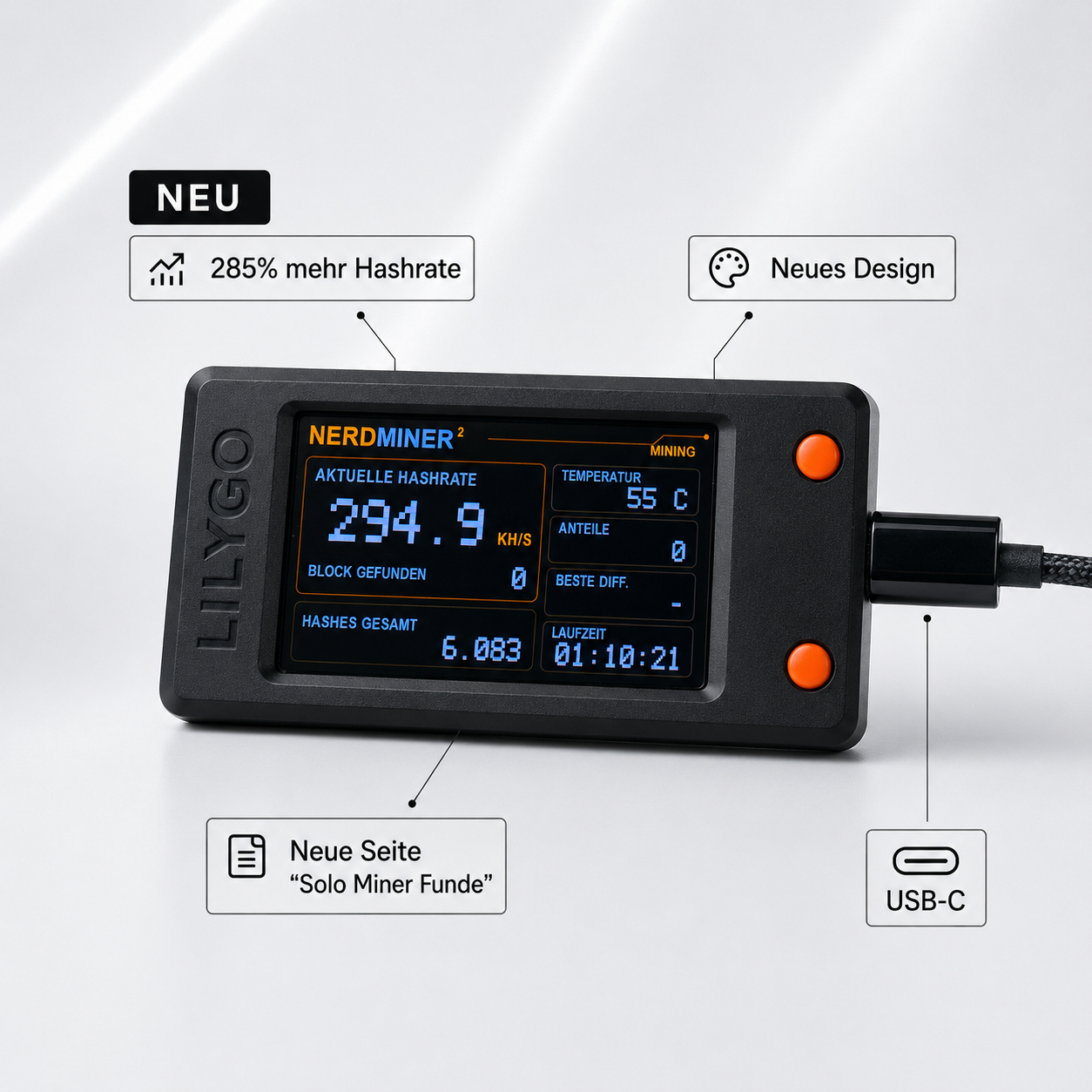
Anyone interested in crypto mining who first wants to learn how the process works should not start directly with a €3,500 altcoin ASIC. The best learning entry point is still the Nerdminer V2 — a €49 USB miner for Bitcoin Solo Mining that will give you all the basic concepts (hashrate, pool, difficulty, block reward) in 3 minutes. Details: Bitcoin Miner Buying Guide.
Frequently Asked Questions about Crypto Miner Comparison
Which crypto miner is most profitable in 2026?
This constantly changes depending on the coin price and network difficulty. Tools like WhatToMine or NiceHash show you in real time which coin is currently providing the best return for your hardware. General answers are always outdated in mining.
Is Altcoin mining worthwhile in Germany?
With household electricity, it is almost never economical. Only with industrial electricity, PV surplus, or waste heat utilization from combined heat and power plants. As a hobby and for learning, even small GPU setups (one RTX 4070) can make sense — the power consumption is only 200-250 W and the CPU can be used in parallel for other tasks.
Can I mine Altcoins with my gaming GPU?
Yes. Nvidia RTX 3070 and higher, AMD RX 6800 and higher are suitable for Kawpow (Ravencoin), Autolykos (Ergo), and other GPU-friendly algorithms. Software like T-Rex Miner or lolMiner starts in 10 minutes on any common Windows or Linux machine.
Is ASIC mining always more profitable than GPU mining?
Per unit hashrate, yes, but ASICs are inflexible: They mine only one algorithm. If that coin crashes, the ASIC becomes worthless. GPUs can switch between coins or be repurposed for other uses.
What happens if a coin changes its mining algorithm?
This has happened: Ethereum switched from Proof-of-Work to Proof-of-Stake in 2022. Millions of dollars worth of GPU mining hardware suddenly became useless for ETH. Anyone who wants to secure their investment should not bet on a single coin.


Teilen: