

Running 24/7, the NerdNOS draws a measured 7.8 watts. That works out at around 68 kWh and roughly €22 of electricity a year on a German household tariff, about the same as a Wi-Fi router. The figures come from a 24-hour measurement with a calibrated energy monitor, not from a data sheet. For those €22 you take part in the bitcoin network with real ASIC hardware: a cheap ticket to follow along, with a small but real lottery chance and a guaranteed learning effect.
See the NerdNOS in the shopThe official figure is "around 8 watts". But what does that actually mean for your electricity bill? What does a NerdNOS really cost you running 24/7, not by marketing but by real measurements with a calibrated energy monitor? This article replaces estimates with hard numbers: measured over 24 hours, broken down into idle, hashing and peak, and set against household appliances and other mining hardware.
The measurement: how the power draw was determined
The numbers in this article come from a measurement with a calibrated class 1 energy monitor (measurement error below 2%), placed between the wall socket and the USB-C power supply that ships with the NerdNOS. It ran for 24 hours of continuous operation at a stable room temperature of 22 °C, with the factory frequency setting of the BM1397 ASIC and a stable 2.4 GHz Wi-Fi connection to public-pool.io.
| State | Power | Note |
|---|---|---|
| Idle (booted, not mining) | 2.1 W | Wi-Fi on, display and fan in low mode |
| Hashing at 95 GH/s | 7.4 W | Mid factory frequency |
| Hashing at 120 GH/s | 8.6 W | Higher factory frequency, fan spins up |
| Peak (boot plus fan ramp) | 9.8 W | Brief spike, under 5 seconds |
| 24-hour average, continuous | 7.8 W | The number that matters |
Average consumption sits steadily at 7.8 watts, marginally below the manufacturer's "around 8 watts". The swing between idle (2.1 W) and hashing peak (8.6 W) comes mostly from the fan ramping up after heat builds. Day to day, the draw is reassuringly even.
Annual cost in euros: the actual sum
At an average draw of 7.8 watts and a German household electricity price of €0.32/kWh (2026 average), the numbers are:
| Period | Consumption | Cost (€0.32/kWh) |
|---|---|---|
| Per hour | 0.0078 kWh | < 1 cent |
| Per day | 0.187 kWh | 6 cents |
| Per month | 5.7 kWh | €1.82 |
| Per year | 68.3 kWh | €21.86 |
| Over 10 years | 683 kWh | €218.60 |
That is about two pizzas a year, for an ASIC solo miner taking part in the bitcoin network around the clock at roughly 120 GH/s. It puts the NerdNOS in a class most households can absorb without thinking about it.
Compared with other household devices
To put those €22 in context, here is how it compares with everyday consumers:
| Device | Average power | Electricity per year |
|---|---|---|
| Nerdminer V2 | 0.95 W | €2.66 |
| NerdNOS | 7.8 W | €21.86 |
| Wi-Fi router | 8–12 W | €22–34 |
| LED bulb (6 h a day) | 8 W | €5.60 |
| Phone charger (24/7) | 0.5 W | €1.40 |
| Laptop idling (8 h a day) | 15 W avg | €14 |
| Fridge (A++) | 30–40 W avg | €84–112 |
| Gaming PC (4 h a day) | 300 W | €140 |
| Antminer S21 (24/7) | 3,500 W | €9,800 |
The NerdNOS uses about as much electricity as a Wi-Fi router, except that instead of serving your internet it is computing bitcoin hashes. Within a household's overall consumption it is a small, steady load.
Where do the 7.8 watts go?
Internally the draw breaks down roughly like this:
- BM1397 ASIC (the hashing core): ~6.2 W, the actual SHA-256 engine
- Active fan: ~0.6 W (low load) up to ~1.0 W (high load)
- OLED display: ~0.2 W
- Wi-Fi module (ESP32): ~0.3 W
- Voltage regulation and losses: ~0.4 W
The bulk, around 80%, goes straight into the BM1397 ASIC. Unlike the V2's microcontroller, this is dedicated mining hardware: every watt produces roughly 12 to 15 GH/s of hash rate. That energy efficiency per hash is orders of magnitude better than the V2, even though the total consumption is clearly higher in absolute terms.
Power draw and solo mining in proportion
So what are you spending those €22 a year on? Let us be honest about it. The NerdNOS hashes at around 120 GH/s. The whole bitcoin network sits at roughly 800 EH/s, about 8 × 10²⁰ hashes per second. Your device contributes a tiny share of that: a single ticket among a great many, redrawn every ten minutes. That is exactly the appeal, because your NerdNOS is in the draw for every block, around the clock.
€22 a year for a real ticket in the bitcoin lottery.
Against those €22 of electricity a year stands a small but real chance at a complete block, plus the learning effect of understanding actual ASIC mining hardware. If your NerdNOS does find a block as a solo miner, the entire reward of 3.125 BTC is yours, with no pool shares taken out. Over the years, occasional solo finds on hobby hardware have been documented. It happens.
For a reward to reach you at all, the NerdNOS needs a valid bitcoin receiving address stored in it. The block's coinbase output goes to exactly that address. Without a wallet address of your own, your device is mining into the void.
What would the NerdNOS cost at other electricity prices?
| Region / tariff | Electricity price | NerdNOS per year |
|---|---|---|
| Germany, household tariff 2026 | €0.32/kWh | €21.86 |
| Austria, household tariff | €0.28/kWh | €19.12 |
| Switzerland, household tariff | CHF 0.24/kWh | €16.40 |
| France (Tarif Bleu) | €0.22/kWh | €15.03 |
| Norway (hydro power) | €0.08/kWh | €5.46 |
| Surplus solar (own use) | €0.07/kWh | €4.78 |
With the NerdNOS the electricity price is not really a hard threshold: even on a German household tariff, €22 a year is in "one pizza less every six months" territory. With your own solar panels it drops well below that.
Waste heat and heating contribution
Unlike the V2, the NerdNOS produces measurable heat. All 7.8 watts end up as waste heat in the room, and the active fan spreads it evenly. In practice that shows up like this:
- Case temperature: hand-warm, about 40 to 45 °C in continuous operation
- Effect on room temperature: in a 15 m² room, +0.03 °C on paper, not measurable
- Contribution to winter heating: on paper about €7 worth of gas equivalent per heating season
- Extra load on air conditioning in summer: negligible (around 0.2 W of extra cooling)
The practical rule: do not put the NerdNOS in a closed drawer or a tight shelf. A little air circulation keeps the fan on its low setting and the case cool.
Compared with other mining devices
| Mining hardware | Power | Hash rate | Cost per year |
|---|---|---|---|
| Nerdminer V2 | 0.95 W | 250 kH/s | €2.66 |
| GekkoScience Compac F | 4–5 W | ~400 GH/s | €11–14 |
| NerdNOS | 7.8 W | ~120 GH/s | €21.86 |
| BitAxe Gamma | 12–16 W | ~1,200 GH/s | €34–45 |
| BitAxe Supra | 40–50 W | ~700 GH/s | €112–140 |
| Antminer S9 (legacy) | 1,300 W | 14 TH/s | €3,640 |
| Antminer S21 | 3,500 W | 200 TH/s | €9,800 |
In energy terms the NerdNOS sits between the GekkoScience Compac F and the BitAxe Gamma, and at around €22 a year it is comfortably within a living-room budget. The step above it (a BitAxe Supra at 40 to 50 W) brings more hash rate, but five to seven times the annual electricity cost.
Efficiency per hash: where the NerdNOS shines
While the V2 is unbeaten on absolute power draw, the NerdNOS wins on energy efficiency per hash:
| Device | J/TH (joules per terahash, lower is better) |
|---|---|
| Nerdminer V2 (ESP32) | ~3,800,000 J/TH |
| NerdNOS (BM1397) | ~65 J/TH |
| BitAxe Gamma (BM1370) | ~14 J/TH |
| Antminer S21 | ~17 J/TH |
The BM1397 ASIC is orders of magnitude more efficient per hash than the ESP32 microcontroller in the V2. The absolute bill still looks higher, because the NerdNOS computes roughly 480,000 times more hashes per second (~120 GH/s against ~250 kH/s). You get far more mining output per cent of electricity spent.
Measuring it yourself
If you want to check the draw of your own NerdNOS, a simple plug-in energy meter is all it takes. Good models (a Brennenstuhl PM231 or a Voltcraft SEM 6000, for instance) cost €15 to €35 and measure to within ±2%.
- Fit the meterPut the energy meter between the wall socket and the USB-C power supply that came with the NerdNOS.
- Measure for 24 hoursLet it run for at least 24 hours so fan ramps and idle phases average out properly. A quick five-minute reading can be off by as much as 30%.
- Read the averageRead off the kWh figure and scale it to a year, or use the average watt reading directly. Done.
Common questions about NerdNOS power consumption
Is the power draw constant over time?
Does a higher frequency give more hash rate without more power?
Can I lower the power draw without losing hash rate?
Is a NerdNOS worth it at my electricity price?
How much CO₂ does the NerdNOS cause?
Is there an eco mode or a sleep mode?
Read on
- Nerdminer guide: every topic at a glance
- What is the NerdNOS? The honest solo miner guide
- Setting up the NerdNOS: step by step in five minutes
- NerdNOS vs Nerdminer V2: which one to buy?
- Mining taxes in Germany
Order a NerdNOS
The complete NerdNOS set, a measured 7.8 W draw, around €22 a year in electricity, free shipping. Real ASIC hardware for the solo mining lottery.
See the NerdNOS in the shop Ships from Germany · BM1397 ASIC · NerdNOS firmware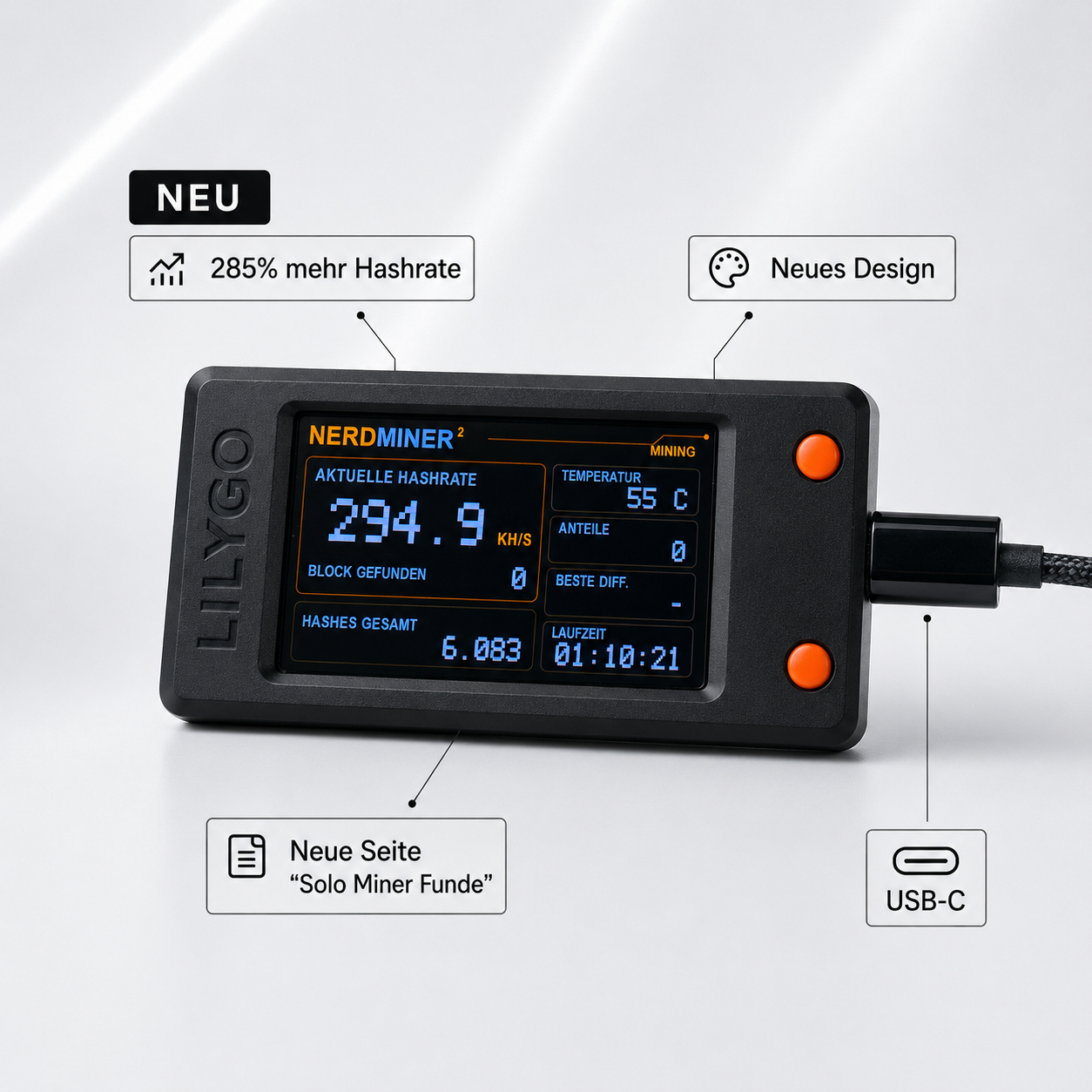


Share: