Short answer
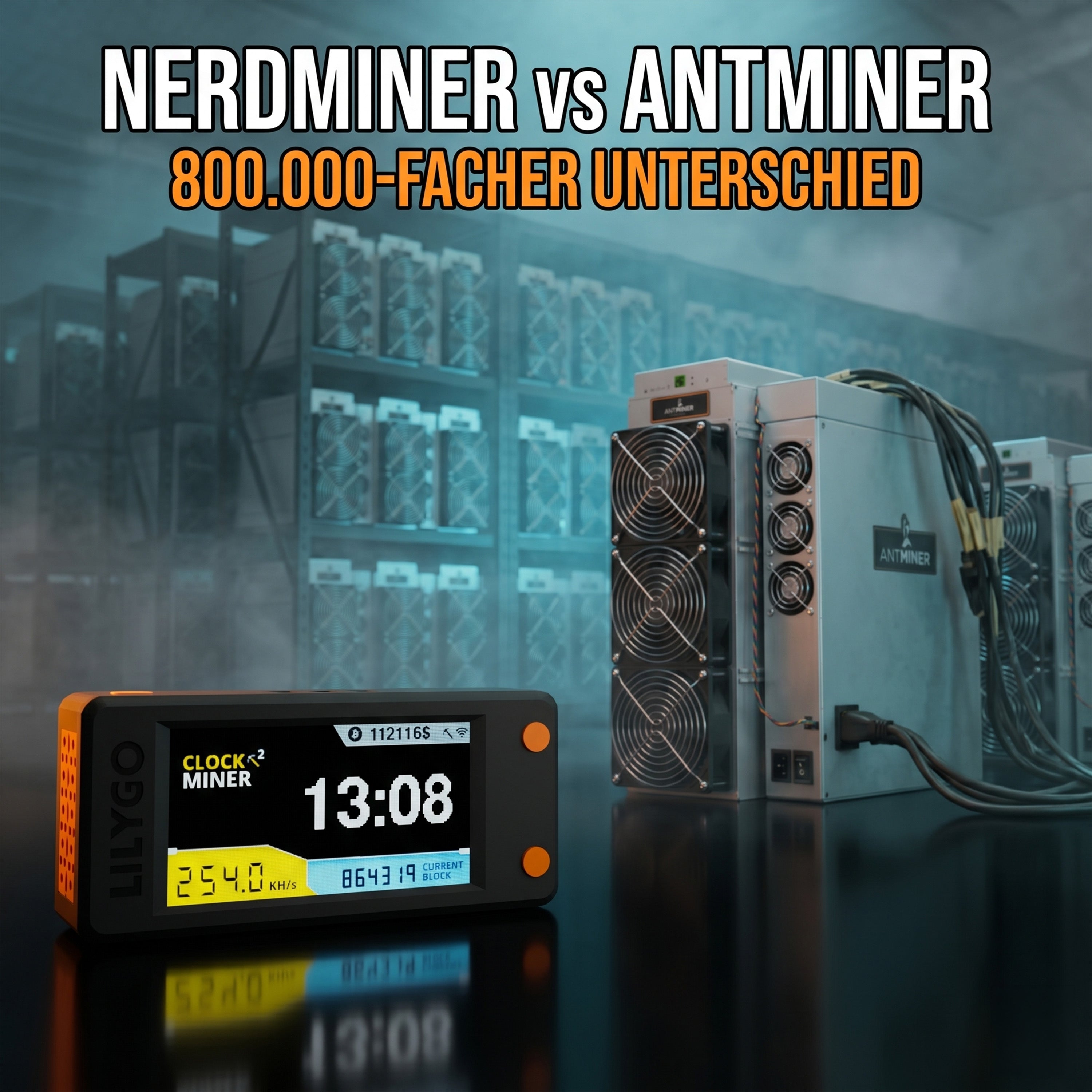
Nerdminer V2 against Antminer S21, two completely different worlds
There are about 800 million times the hash rate between them. The Antminer S21 is industrial capital equipment that only works out on cheap industrial electricity; on German household rates it loses money outright. The Nerdminer V2 is the opposite: a silent learning device and lottery ticket for the home that costs practically nothing to run (around €0.23 a month). If you are looking for the gap in between, you end up at the NerdNOS or a BitAxe.
Comparing a Nerdminer V2 with an Antminer S21 is like putting a child's bicycle up against a Formula 1 car. The hash rate difference is a factor of about 800 million (200 TH/s ÷ 250 kH/s). Running costs differ by a factor of 3,684. Price by a factor of 71. And the comparison is still worth making, because it explains why both devices have a place in the bitcoin world of 2026 while addressing completely different people. This article lays out the real dimensions of both classes and answers which device makes sense in which situation.
The bare numbers
| Criterion | Nerdminer V2 | Antminer S21 | Factor |
|---|---|---|---|
| Price | €48.99 | €3,500 | 71× more |
| Hash rate | 250 kH/s (0.00025 TH/s) | 200 TH/s | ~800m× more |
| Power draw | 0.95 W | 3,500 W | 3,684× more |
| Annual electricity (€0.32/kWh) | €2.80 | around €9,800 | 3,500× more |
| Noise | completely silent | ~75 dB (vacuum cleaner level) | — |
| Weight | 30 g | ~15 kg | 500× more |
| Dimensions | 60×35×15 mm | 400×195×290 mm | ~1000× the volume |
| Block chance per day (solo) | 0.000000000058 | around 0.046 (≈ 4.6 %) | ~800m× |
| Expected time to a block (solo) | statistically millions of years, a pure lottery ticket | ~59 years | ~800m× |
| Setup complexity | 3 minutes, plug and play | network config, pool setup, cooling, power supply check | — |
The Antminer S21 in detail
The Antminer S21 is the current bestseller in the professional ASIC segment. Made by Bitmain, the world's largest manufacturer of bitcoin mining hardware, it is the direct successor to the S19 series. The key specifications:
-
Hash rate:
200 TH/s(±3 % depending on firmware version) -
Power draw:
3,500 Wat full load (17.5 J/TH efficiency) - Chipset: 132 BM1466 ASICs running in parallel
- Cooling: 4 large axial fans, around 75 dB at full load
- Form factor: 195×290×400 mm, 15.3 kg, rack mountable
- Power supply: integrated, needs 200-240 V three-phase or 2× 110-120 V
- Network: 1 gigabit Ethernet
- List price (as of April 2026): €3,500-4,500 depending on retailer and availability
Why the Antminer S21 does not pay off in Germany
Let us work through the economics concretely. Assumptions: the S21 runs 24/7, the bitcoin price is around €63,000, network hash rate 620 EH/s, German household electricity at €0.32/kWh.
Daily revenue:
- Share of network hash rate:
200 TH/s÷620 EH/s= 0.0000323 % - 450 BTC are issued daily (144 blocks a day × 3.125 BTC after the halving)
- Expected share: 0.0000323 % × 450 BTC ≈
0.0000145 BTC/day≈ about €0.91 a day - Gross revenue per month: ~€27
Daily cost:
- Consumption per day: 3.5 kW × 24 h = 84 kWh
- Electricity per day: 84 × €0.32 =
€26.88 - Electricity per month: ~€810
Monthly result: about €27 of revenue less €810 of electricity = around −€780 a month.
Which means: running an Antminer S21 in a German household at normal electricity prices costs roughly €9,800 a year in electricity alone. The miner itself costs another €3,500-4,500 on top. On German household electricity the S21 is a clear loss maker; it burns electricity instead of producing a profit.
Where the Antminer S21 does make sense
The S21 only becomes profitable at industrial electricity prices below €0.07/kWh. Only a few settings reach that:
- Paraguay with its surplus hydro power (Itaipú), often below €0.04/kWh for mining customers
- Texas with a deregulated market and surplus wind and solar, €0.03-0.06/kWh
- Kazakhstan and Russia with subsidised coal and gas power, below €0.05/kWh
- Bhutan with state-owned hydro, below €0.04/kWh
- German households with solar surplus: if your solar power would otherwise be exported for 6 to 8 cents per kWh, a miner lets you keep it, which effectively reduces the electricity price to the export income you give up
Outside those scenarios the S21 is not an economic device but an expensive toy for well-off bitcoin enthusiasts.
And the Nerdminer V2?
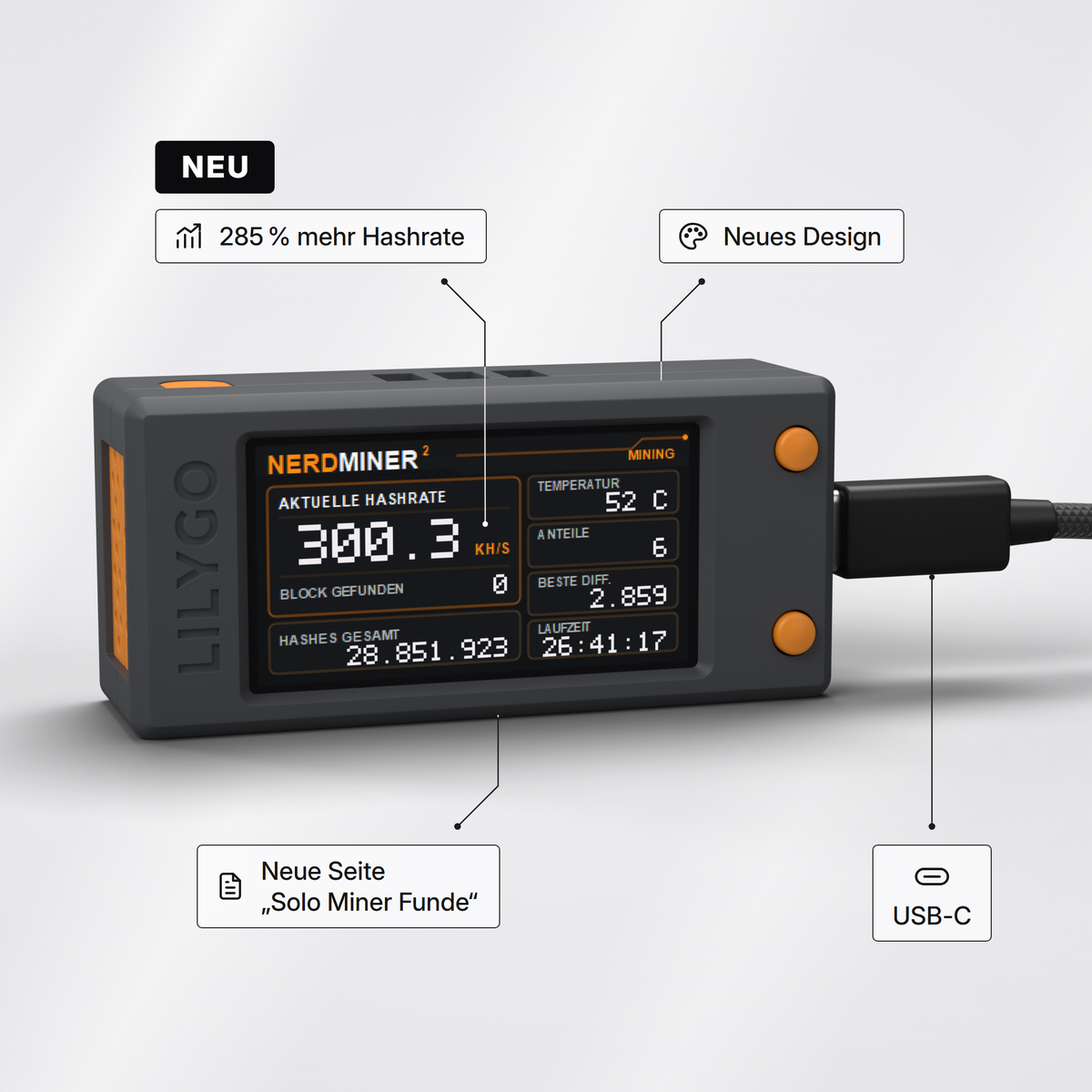
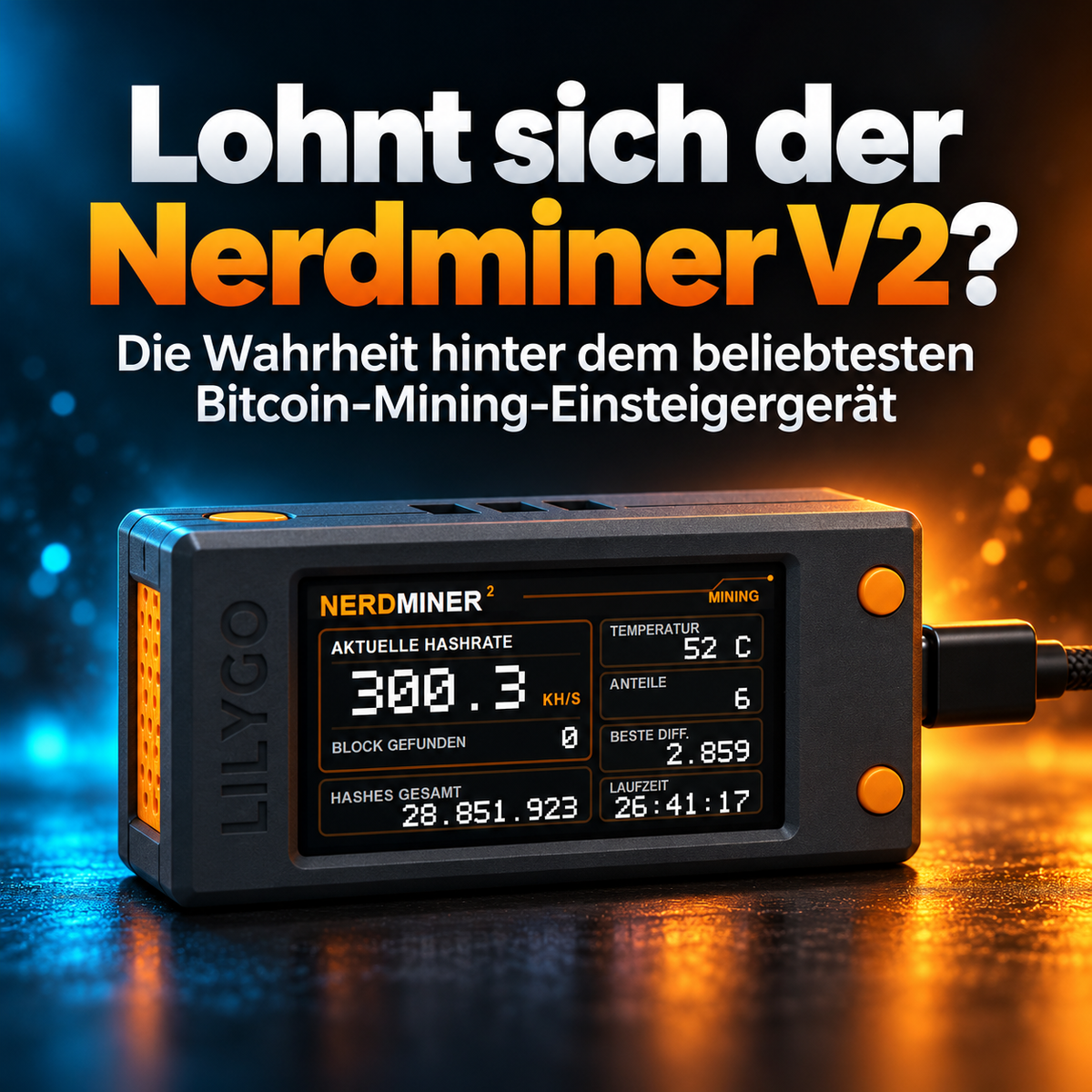
The Nerdminer V2 is the exact opposite of the S21: educationally valuable, irrelevant in electrical terms, mathematically a lottery ticket. The running cost difference: the Nerdminer draws around €0.23 a month, so it effectively runs for free. If it ever hit the jackpot, the return on investment would be four figures. As a lottery ticket, what counts is the chance, not the statistical average.
So a win can actually reach you: your own bitcoin address
If your Nerdminer finds a block solo, the reward goes straight to the bitcoin address you store on the device. No address, no payout. We recommend a free account at eToro (EU regulated), where you'll find your receive address in the eToro wallet. Prefer a wallet that only you control? Then Tangem, 10% off through our link.
Free account at eToro →eToro risk warning: Your capital is at risk. Crypto assets are highly volatile, other fees and taxes may apply.
Noise and space, the overlooked factors
Hash rate numbers dominate every discussion, but in practice noise and space are often the real deciding factor.
Antminer S21:
- 75 dB (comparable to a powerful vacuum cleaner or a lawnmower)
- Absolutely not suitable for a living space; you need a cellar, a garage or a separate outbuilding
- Produces about 12,000 BTU/h of waste heat (a small room heater), usable for heating in winter, a cooling problem in summer
- Needs a dedicated 200-240 V connection or 2 separate 110-120 V circuits
Nerdminer V2:
- Completely silent; a microphone test shows 0 dB above room noise
- Fine in a living room, a bedroom or an office
- No meaningful waste heat (less than a phone while charging)
- Standard USB power, no special power supply
The paradox: both are legitimate
Although the two classes are about 800 million times apart, the Nerdminer V2 and the Antminer S21 are both legitimate bitcoin mining devices, just for completely different purposes:
- The Antminer S21 is capital equipment. It runs in mining farms under industrial conditions, produces measurable revenue and forms part of a business model. Anyone running one privately at home does so out of enthusiasm despite the loss, or has very particular electricity terms.
- The Nerdminer V2 is an educational device. It runs on desks, produces practically no revenue and is part of a learning and experimenting setup. It participates in the bitcoin network as a fully valid miner, but at a level where the economic component is negligible.
Common questions about the comparison
Can I buy a used Antminer as an alternative to the Nerdminer?
In theory yes, in practice no. Used Antminer S9s start at €50, so in Nerdminer territory. But the S9 draws 1,300 watts, is extremely loud (72 dB) and produces as much waste heat as a small radiator. For an ordinary living room it is entirely unsuitable, even though it technically offers more hash rate.
Which device finds a block faster?
In expectation the Antminer S21, around 800 million times faster. Statistically both remain chance. There have been Nerdminer owners who found a block after a few months, and Antminer operators who went weeks without one. Mining is a Poisson-distributed lottery, and expected values are not guarantees.
At what electricity price does an Antminer run profitably?
At the current difficulty and bitcoin price the break-even for an Antminer S21 sits at roughly €0.07-0.08/kWh. Anything below that is profitable, anything above costs money on balance.
Can I run an Antminer in a rented flat?
Legally yes, bitcoin mining is legal in Germany. Practically no: 75 dB of constant noise and a 3,500 W continuous draw sit badly with almost any tenancy agreement and almost any set of neighbours.
Is there anything between the Nerdminer and the Antminer?
Yes, compact single ASICs fill exactly that gap. Our NerdNOS uses a real BM1397 ASIC, delivers around 100 GH/s at only 7-8 W over USB-C, costs €99 and is plug and play: considerably more hash rate than the V2, yet silent and fine in a living room, unlike an industrial ASIC. Alongside it there are open source boards such as the BitAxe Gamma (1 TH/s, 15 W, €150-200). Detailed comparison: Nerdminer V2 vs BitAxe.
Conclusion
The Antminer S21 is industrial bitcoin infrastructure in rack format. The Nerdminer V2 is a bitcoin education device in desk format. Both are genuine mining hardware, but they answer completely different questions. If you want to mine seriously and for profit, you need industrial electricity and a professional ASIC like the Antminer. If you want to understand mining, play with it and learn from it, a Nerdminer V2 or the slightly stronger NerdNOS serves you well. Most private customers in Germany fall into the second group.
Read on
Get into bitcoin mining, quietly
The Nerdminer V2 is the affordable, silent way in from €48.99. If you want more hash rate on your lottery ticket, take the NerdNOS with its real BM1397 ASIC.
To the Nerdminer V2 in the shop → To the NerdNOS in the shop → Plug & play · silent · made for homeeToro risk warning (advertising): eToro is a multi-asset platform which offers both investing in stocks and trading CFDs. CFDs are complex instruments and come with a high risk of losing money rapidly due to leverage. 50% of retail investor accounts lose money when trading CFDs with this provider. You should consider whether you understand how CFDs work and whether you can afford to take the high risk of losing your money. Crypto investments are high risk and highly volatile. Crypto trading at eToro (Europe) Ltd. is provided by DLT Finance, crypto custody by Tangany. Taxes may apply. Your capital is at risk. We earn a commission on accounts opened through the eToro links on this page.


Teilen: