Buying Bitcoin Miners in 2026 — The Complete Buying Guide for Every Budget Class
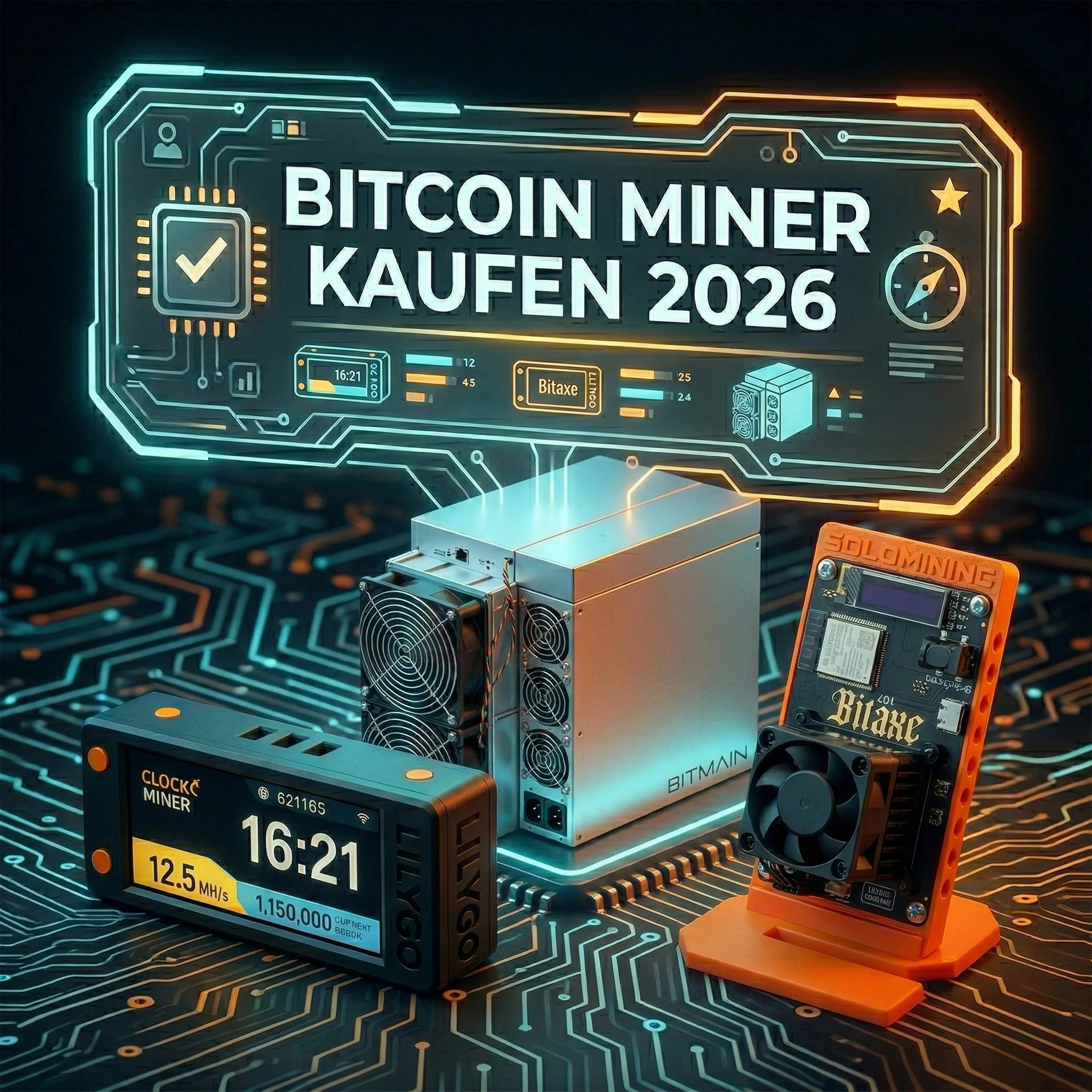
Anyone looking to buy a Bitcoin miner in 2026 faces a confusing selection: €50 USB devices, €200 open-source boards, €3,500 ASIC professional machines, and a growing number of hybrid solutions in between. This guide categorizes all Bitcoin mining devices, shows you exact hashrate-to-price ratios, and tells you honestly which miner truly makes sense for your situation—without marketing jargon.
A preliminary note: If you want Bitcoin purely as an investment, buying directly through an exchange is more economical than mining in almost every scenario. Mining is currently worthwhile in three specific cases: (1) as a learning and lottery device in the mini-range, (2) as a hobby with a real block chance in the mid-range, (3) as a business model with industrial power in the professional range. Anything in between usually just burns money.
The Four Classes of Bitcoin Miners 2026
| Class | Price Range | Hashrate | Power Consumption | Target Audience |
|---|---|---|---|---|
| USB Solo Miners | €40 – €100 | 100 – 300 KH/s | < 1 W | Beginners, Learners, Gift Buyers |
| Open-Source Boards (BitAxe / NerdNOS) | €150 – €350 | 0.5 – 5 TH/s | 10 – 50 W | Tech Enthusiasts, Hobby Solo Miners |
| Used Professional ASICs | €300 – €1,500 | 50 – 110 TH/s | 1,500 – 3,200 W | Tinkerers with Cheap Electricity |
| New Professional ASICs (Antminer S21, Whatsminer M60) | €2,800 – €5,500 | 180 – 250 TH/s | 3,300 – 3,800 W | Professional Miners, Mining Farms |
Class 1: USB Solo Miners (€40-100) — The Lottery Ticket Class
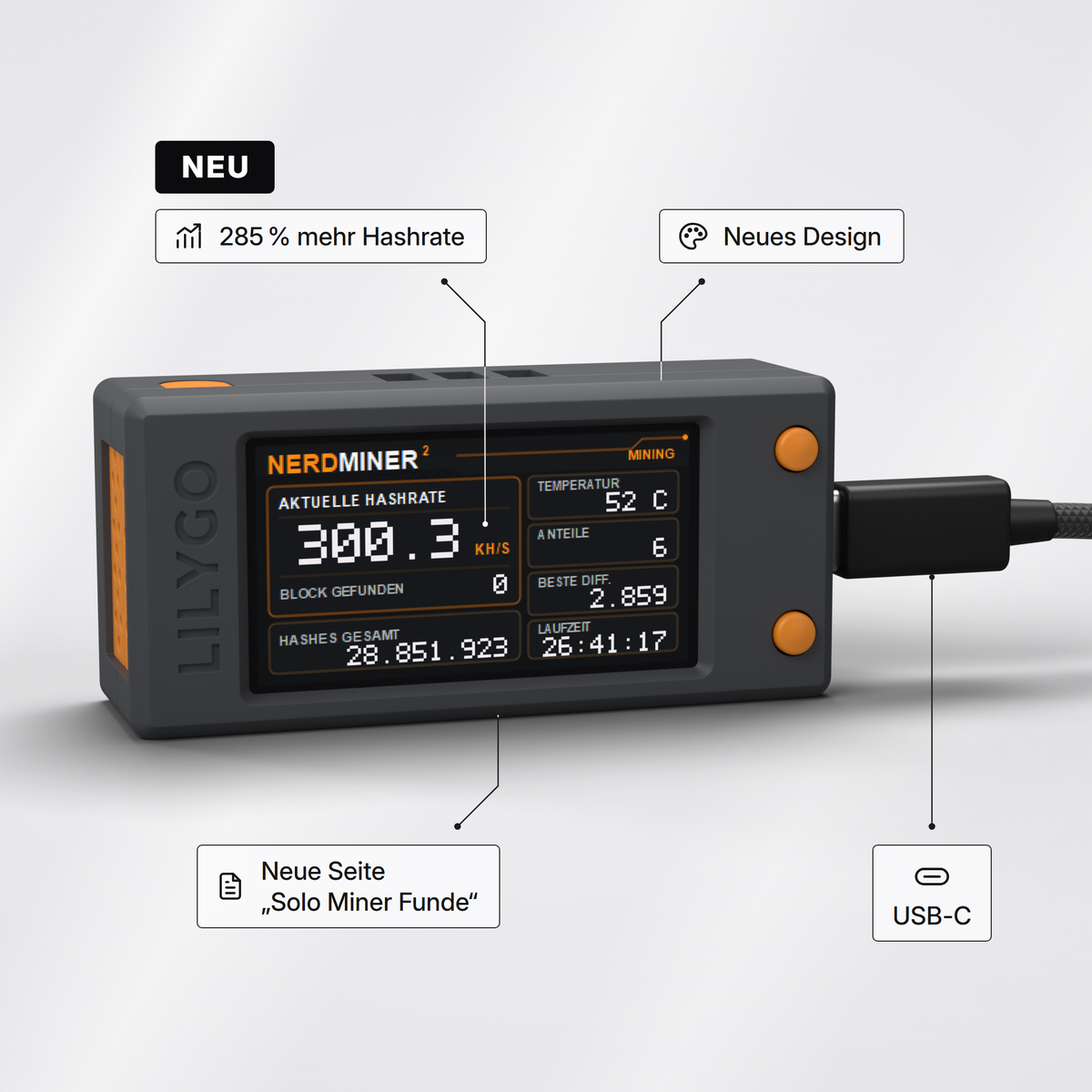
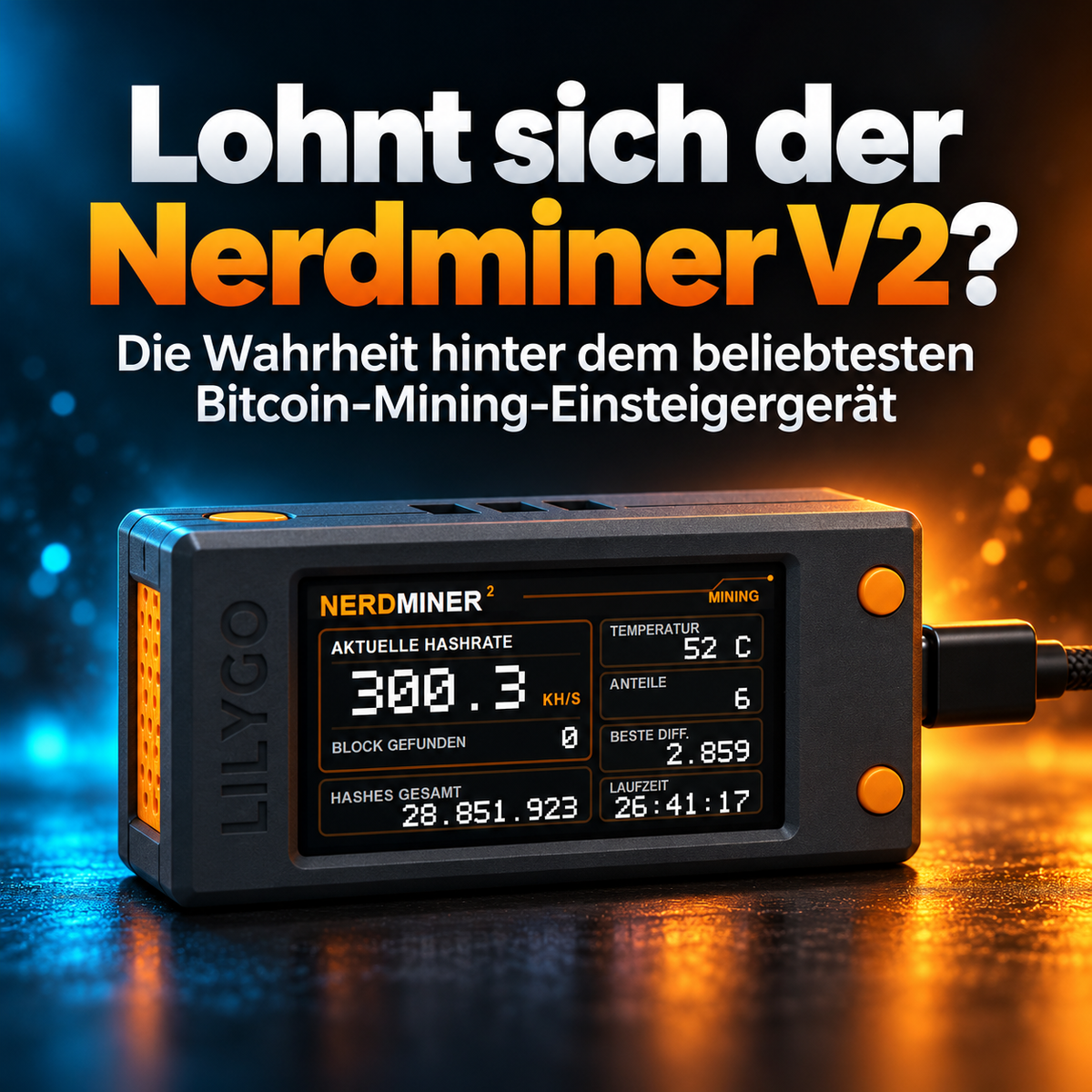
The cheapest entry class includes mini-devices like the Nerdminer V2, which participate in the Bitcoin network as full-fledged solo miners but with extremely low hashrate. Statistically, the probability of finding a block with them is negligible — but the electricity costs are so low (under €3 per year) that you can play along for years without loss.
Typical candidates in this class:
- Nerdminer V2 (Standard) — €48.99, 230-250 KH/s, OLED display, Plug & Play
- Nerdminer V2 with fan — €64.99, colored variants, better continuous load
- NerdNOS (Community variant) — €80-100, alternative firmware
Why this class makes sense: You understand Bitcoin mining firsthand, see live data on the display, require no setup know-how, and risk no money. Economically a lottery ticket, pedagogically and emotionally worth every cent.
Why this class doesn't make sense: If you expect to earn any Bitcoin with it. Mathematically, the average block takes about 47,500 years.
Detailed selection criteria for this class can be found in the article Buying a Nerdminer — What to Look For, and a market overview in the Nerdminer Alternatives Comparison 2026.
Class 2: Open-Source Boards (€150-350) — The Hobby Solo Class
One level above are open-source miners, developed by the Bitcoin community, offering significantly higher hashrates. The best-known representatives:
- BitAxe Gamma (€150-200) — 1 TH/s, approx. 15 W, single BM1366 chip from the Antminer S19 Pro
- BitAxe Ultra (€180-250) — 1.5-2 TH/s, approx. 18-22 W
- BitAxe Supra / NerdOctaxe (€300-500) — 4-8 TH/s, 40-80 W
- Loki Miner / OSMU Boards (€200-400) — Community variants with different ASIC chip configurations
These devices bring hashrates to a level where finding a block is still a lottery, but statistically becomes realistic every 2-10 years. They are louder (small fan needed), somewhat more power-hungry, and usually require firmware knowledge.
Deep-dive into this class: Nerdminer V2 vs. BitAxe — when is the extra cost worth it?
Class 3: Used Professional ASICs (€300-1,500) — The Niche for Tinkerers
Older Antminer models (S9, S17, S19 series) are flooding the used market in 2026 as professional mining farms upgrade to newer S21 models. For private individuals with extremely cheap electricity (photovoltaic surplus, district heating offset, industrial access), these devices can indeed be profitable.
- Antminer S9 (2017) — €50-150, 13.5 TH/s, 1,300 W, very loud, now only a niche candidate
- Antminer S17/S17 Pro (2019) — €150-350, 56 TH/s, 2,500 W, significantly more efficient
- Antminer S19 / S19j Pro (2020/2021) — €500-1,200, 95-104 TH/s, 3,050-3,250 W, workhorse of the last 4 years
Important: In Germany, this class is not profitable with normal household electricity prices (€0.32/kWh). Calculation example: Antminer S19j Pro runs 24/7 with 3,200 W → 28 kWh/day → €9/day electricity → €270/month. The achievable mining return at current rates and difficulty is a maximum of €100-150 per month. Loss: €120-170 monthly.
Direct comparison: Nerdminer V2 vs. Antminer S21 — David against Goliath.
Class 4: New Professional ASICs (€2,800-5,500) — The Industrial Class
The current flagship models represent the technological maximum:
- Bitmain Antminer S21 — 200 TH/s, 3,500 W, approx. 17.5 J/TH efficiency, €3,500-4,500
- Bitmain Antminer S21 Pro — 234 TH/s, 3,510 W, 15 J/TH, €5,000-5,500
- MicroBT Whatsminer M60 — 170-220 TH/s, 3,300-3,800 W, similar efficiency to S21
- Canaan Avalon A1466 — 150 TH/s, 3,200 W, as a price-performance option
This class is only profitable with industrial electricity below €0.08/kWh. Countries like Paraguay, parts of the USA (Texas), Kazakhstan, or Norway are the hotspots. In Germany, operation is only sensible with self-generated electricity (PV surplus, combined heat and power waste heat utilization).
The Most Important Decision: Pool or Solo?
Regardless of the device choice, you must decide whether to mine in solo mode (full block reward upon success, but extremely rare successes) or pool mode (regular small payouts, but 1-3% pool fee). Most USB solo miners are configured for solo by default, professional ASICs for pool. Detailed decision-making help including mathematics can be found in Solo Mining vs. Pool Mining — which mode suits you?
What to Look For When Buying — The 6-Point Checklist
- Up-to-date firmware ex works. Especially with USB miners, outdated firmware can mean a 30-40% hashrate loss. Look for "pre-configured with current firmware" or "firmware 1.8.3" for the Nerdminer V2.
- Delivery time under one week. From Asia, 3-4 weeks is standard, plus potential customs fees. From the EU, 2-3 business days without additional costs.
- Return policy and warranty. 14-day right of withdrawal and 2-year warranty under EU distance selling law are only available from retailers based in the EU.
- Accessible support. If you have problems, you don't want a 5-day email ping-pong in broken English. German support usually responds within 24 hours.
- Payment with buyer protection. PayPal, Klarna, credit card instead of advance bank transfer. Especially for devices over €200, reputable payment methods are not a luxury, but standard equipment.
- Power consumption matching your goal. Before you buy a 3,500 W miner, honestly calculate: How much electricity do you pay per kWh? How many hours per day do you want to run it? How much return do you expect? In 90% of German households, this calculation answers the buying decision itself.
Specific Purchase Recommendations by Budget
Budget up to €100 — USB Solo Miners
The Nerdminer V2 is the clear market leader in this class: most widespread, best firmware maintenance, available pre-configured. If you want the colored variant with a fan, go for the Nerdminer V2 with fan.
Budget €150-350 — Hobby Solo / BitAxe
The BitAxe Gamma is the gold standard: 1 TH/s, stable firmware, good community documentation. If you want more, look at the Supra or OctaXe variants.
Budget €500-1,500 — Used Professional ASICs
Only sensible if you have a cheap power source. The Antminer S19j Pro (95 TH/s, used approx. €800-1,200) currently offers the best price-performance ratio in the used market.
Budget €3,000+ — New Professional ASICs
Antminer S21 or Whatsminer M60. Only sensible with access to industrial electricity or with your own PV system with surplus feed-in.
Frequently Asked Questions About Buying Bitcoin Miners
Can I buy an economically sensible Bitcoin miner for €200?
Honestly: no — if "economically" means you'll make money with it. For €200, you'll get a BitAxe Gamma, which runs barely break-even with German electricity prices. If "economically" means you get maximum educational value, a €50 Nerdminer V2 is better invested money.
What is the difference between a USB miner and an ASIC miner?
Both are technically ASIC miners (Application-Specific Integrated Circuit). "USB miners" refers to the subgroup with USB power supply and very low hashrate (< 1 TH/s), while "ASIC miners" is colloquially used for the large professional devices with their own power supply.
Can I simply buy a Bitcoin miner at an electronics retailer or supermarket?
No, these devices are too niche. You need a specialized retailer — either online (specialty shop in Germany), directly from the manufacturer (Bitmain, MicroBT), or from the used market (eBay, specialized marketplaces).
Can I repurpose my old graphics card for Bitcoin mining?
No. GPUs have been completely uneconomical for Bitcoin since 2013 — an ASIC is a thousand times more efficient. Your graphics card is at best suitable for alternative cryptocurrencies with ASIC-resistant algorithms (Ravencoin, Ergo, Kaspa — see Crypto Miner Comparison for Altcoins).
How long does a Bitcoin miner last?
Professional ASICs are designed for 3-5 years of continuous operation. After that, efficiency decreases, or difficulty increases so much that the hardware becomes uneconomical. USB mini-miners can last 10+ years because they experience hardly any thermal stress.


Teilen: