
Bitcoin Mining Taxes Germany 2026 — The Complete Guide
Bitcoin mining is legal in Germany — but subject to tax. The tax treatment of mining income is one of the most complex topics in German crypto law and has been clarified in recent years through several BFH rulings and BMF circulars. This guide explains in clear German what you need to know as a hobby miner, solo miner, or professional operator — without legal jargon, but with all relevant paragraphs as references.
Note: This article is general guidance and not tax advice. In case of doubt, consult a tax advisor with crypto experience.
The Basic Rule: Mining Income is Other Income
According to the BMF circular of May 10, 2022 ("Specific questions on the income tax treatment of virtual currencies and other tokens"), mining income is considered other income under § 22 No. 3 EStG. This means:
- Mined coins are valued at the time of receipt (i.e., the moment they land in your wallet) — at the current market value in Euro.
- There is a tax-free limit of €256 per year for all other income combined. Below this, everything is tax-free. Above this, the entire amount is taxed (not just the part above €256).
- The tax rate is your personal income tax rate (14-45% depending on total income).
Hobby Mining vs. Commercial Mining
The tax office distinguishes between two categories that are treated completely differently for tax purposes:
Hobby Mining (private)
- You mine for yourself, without systematic profit motive
- Income = other income (§ 22 No. 3 EStG)
- Tax-free limit: €256 per year
- Mined coins upon later sale: 1-year holding period for tax-free sale (§ 23 EStG)
- Electricity costs and hardware deductible as income-related expenses (up to the amount of income)
- No trade tax, no VAT
Commercial Mining
- Systematic operation with profit motive (e.g., multiple ASICs, own electricity contracts)
- Income = income from commercial operations (§ 15 EStG)
- Business registration required
- Trade tax from €24,500 profit/year (tax-free amount)
- VAT: According to current jurisprudence, mining is not subject to VAT (no exchange of services)
- No 1-year holding period — mined coins are immediately business assets
- Hardware depreciation possible over 3-5 years (AfA)
When does a hobby become a commercial activity?
There is no fixed criterion in law. Tax offices look at the overall circumstances:
- Clearly a hobby: A Nerdminer V2 on the desk (€50, 1 W power, ~€0 income). No tax office would ever determine a profit motive here.
- Grey area: 2-3 BitAxe boards (€400-600 investment, 40-60 W, marginal income). Could be either.
- Clearly commercial: 5+ Antminers in the basement (€15,000+ investment, own power connection, daily income). Here, the tax office assumes commercial activity.
When in doubt: If you invest more than €500-1,000 per year in mining hardware and generate regular income, proactively speak with a tax advisor. Retrospective reclassification by the tax office is more expensive than prior consultation.
Tax Treatment by Scenario
Scenario 1: Nerdminer V2 (Hobby, no income)
The typical case for readers of this blog. You operate a Nerdminer V2 as a learning device:
- Annual income: statistically ~0.000003 BTC (= ~€0.18). Practically zero.
- Tax liability: None. Below €256 tax-free limit, no taxable event.
- Tax declaration: Not necessary (as long as you have no other miscellaneous income above €256).
- Record-keeping obligation: Formally yes (you should document that you are mining), but for Nerdminer scale, practically irrelevant.
Scenario 2: Nerdminer actually finds a block
If the extremely unlikely happens and you find a block with a Nerdminer V2:
- Income: 3.125 BTC + transaction fees = approx. €180,000 at the time of receipt.
- Immediate tax liability: €180,000 as other income in the calendar year the block is found.
- Tax burden (depending on total income): For €180,000 of additional income, typically 42-45% tax rate = €75,600-€81,000 income tax plus solidarity surcharge.
- Problem: You have Bitcoin, but you need Euros for tax payment. If you don't sell the BTC immediately and the price falls, you pay taxes on a value you no longer have.
- Recommendation: Immediately exchange a portion of the Bitcoin into Euros to cover the tax burden. Or contact a tax advisor before doing anything.
Scenario 3: Pool Mining with Professional Hardware
- Regular income from pool mining is continuously taxable.
- Every payout from the pool is a taxable inflow.
- All payouts must be documented: date, amount in BTC, EUR exchange rate at the time, pool name.
- Electricity costs deductible as income-related expenses (for hobby) or operating expenses (for commercial).
- Hardware acquisition deductible immediately as income-related expenses (for hobby under €800 net) or depreciable via AfA (for commercial).
What happens when mined Bitcoin is sold?
Mined Bitcoin is not free — its acquisition value corresponds to the EUR exchange rate at the time of mining (inflow). If you sell it later:
- Sale within 1 year: Capital gain = selling price minus acquisition value. Taxable as a private sale transaction (§ 23 EStG), with a tax-free limit of €1,000 per year.
- Sale after 1+ years: Tax-free capital gain (only applies to private hobby mining, not for commercial).
Example: You mine 0.01 BTC at a rate of €60,000/BTC. Acquisition value = €600. Sale 6 months later at €80,000/BTC = €800. Capital gain = €200 (below €1,000 tax-free limit = tax-free). Sale after 13 months: completely tax-free, regardless of the profit.
Documentation Obligation — what do you need to keep?
The tax office can request proof at any time. As a miner, you should document:
- Hardware purchase receipts (invoices for Nerdminer, BitAxe, ASICs, etc.)
- Pool statistics / payouts (screenshots or CSV exports from your pool dashboard)
- Wallet transaction history (all inflows and outflows with date and EUR exchange rate)
- Electricity cost receipts (if you deduct electricity costs as income-related expenses: annual electricity bill + calculation of the mining share)
- Mining setup documentation (which devices, which hashrate, which pool, when operated)
Retention period: 10 years for commercial mining, 6 years for private.
Trade Tax — when relevant?
Trade tax is only incurred if the tax office classifies your mining as a trade AND the trade profit exceeds €24,500 per year. The amount of trade tax depends on your municipality's assessment rate (typically 300-450%). In practice, trade tax only affects professional mining farms — hobby miners are never affected.
VAT — not relevant for mining
The BMF circular of May 2022 clarifies: Mining is not subject to VAT. There is no exchange of services — you do not provide a service to an identifiable recipient, but rather secure the Bitcoin network as a whole. The block reward comes from the protocol, not from a customer. Therefore: no VAT, no input tax deduction possibility.
Tax Tools for Miners
Manual calculation quickly becomes unwieldy for pool mining with weekly payouts. Helpful tools:
- Blockpit: Austrian crypto tax tool with German tax logic, imports pool payouts and wallet transactions
- CoinTracking: German tool, very detailed, also suitable for mining
- Accointing (by Glassnode): Modern interface, good import for mining pools
- Koinly: International tool with German tax report
All mentioned tools generate a tax report that you can submit directly to your tax advisor or the tax office.
Frequent Questions about Mining Taxes in Germany
Do I have to declare my Nerdminer V2 in my tax return?
Only if you actually generate mining income. For a Nerdminer V2 with statistically zero income per year, no declaration is necessary.
What happens if I don't declare my mining income?
Tax evasion according to § 370 AO. For small amounts, back payments plus interest may be incurred; for large amounts, criminal consequences. Since 2023, German tax authorities have access to data from crypto exchanges (MiCA reporting obligation) — lack of transparency is becoming increasingly risky.
Can I deduct electricity costs as income-related expenses?
Yes, for hobby mining as income-related expenses (up to the amount of income). For commercial mining as operating expenses (unlimited). Documentation: annual electricity bill, calculate the miner's share of total electricity consumption (e.g., 1 W mining / 3,500 W total household = 0.03%).
Are crypto gifts (e.g., gifting mined Bitcoin) tax-free?
Gift tax only applies above €20,000 (for non-relatives) or €500,000 (for spouses). Irrelevant for typical mining amounts. Gifting does not interrupt the 1-year holding period — the recipient assumes the donor's holding period.
Do I have to register a business if I operate an Antminer?
Not mandatory, but recommended. If the tax office retrospectively assumes commercial activity, back payments and late fees may be incurred. Proactive registration is cheaper than retrospective correction.
Further Reading
- Bitcoin Mining Beginner's Guide 2026
- Bitcoin Mining at Home — Realistic or Money Pit?
- Nerdminer V2 Power Consumption — Measured
- Crypto Mining — the German Legal Term
- Bitcoin Solo Mining Practical Guide
Start Mining
Nerdminer V2 — your entry into Bitcoin Mining from €48.99
To the Nerdminer V2 in the Shop →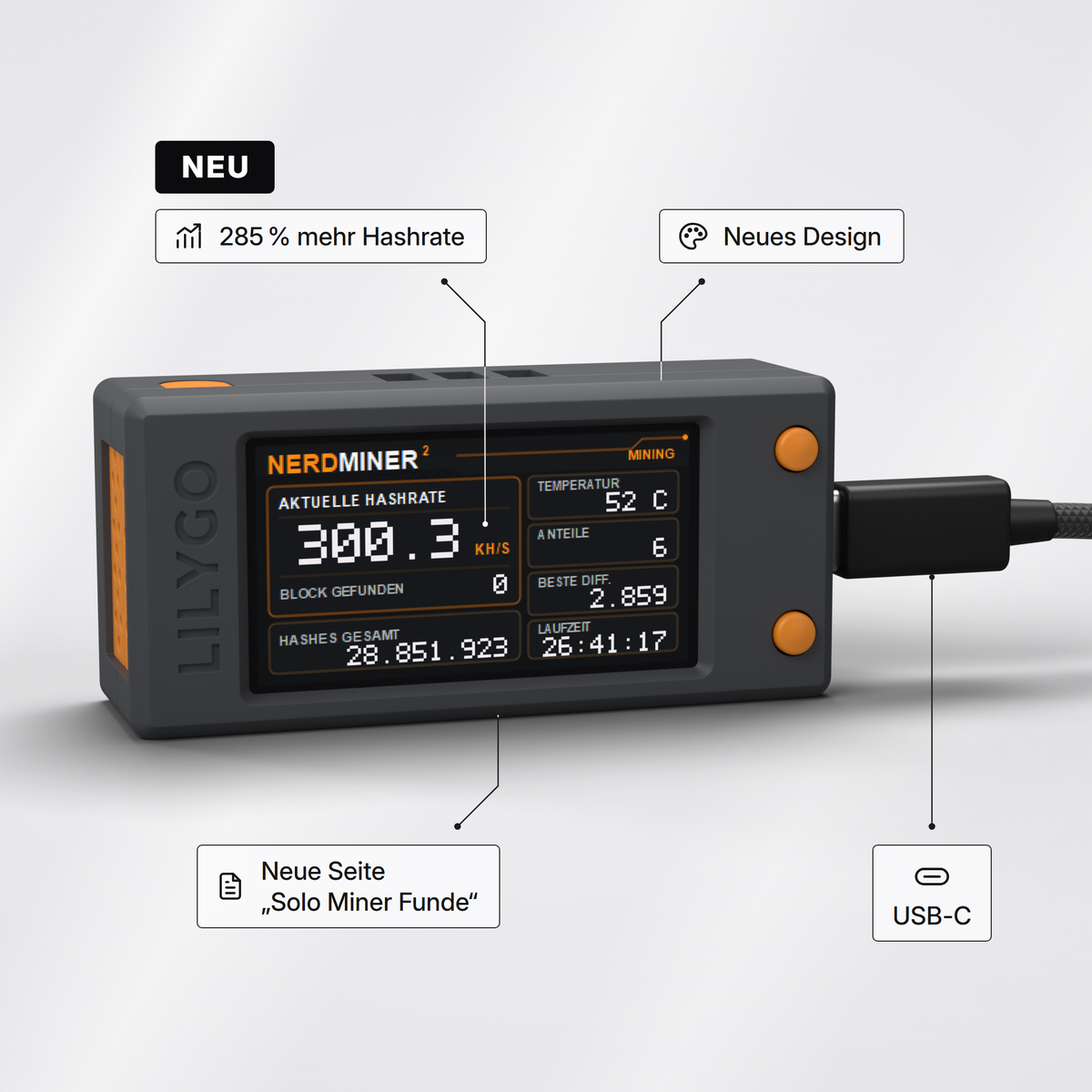


Teilen: