Short answer
Bitcoin mining at home, what actually works
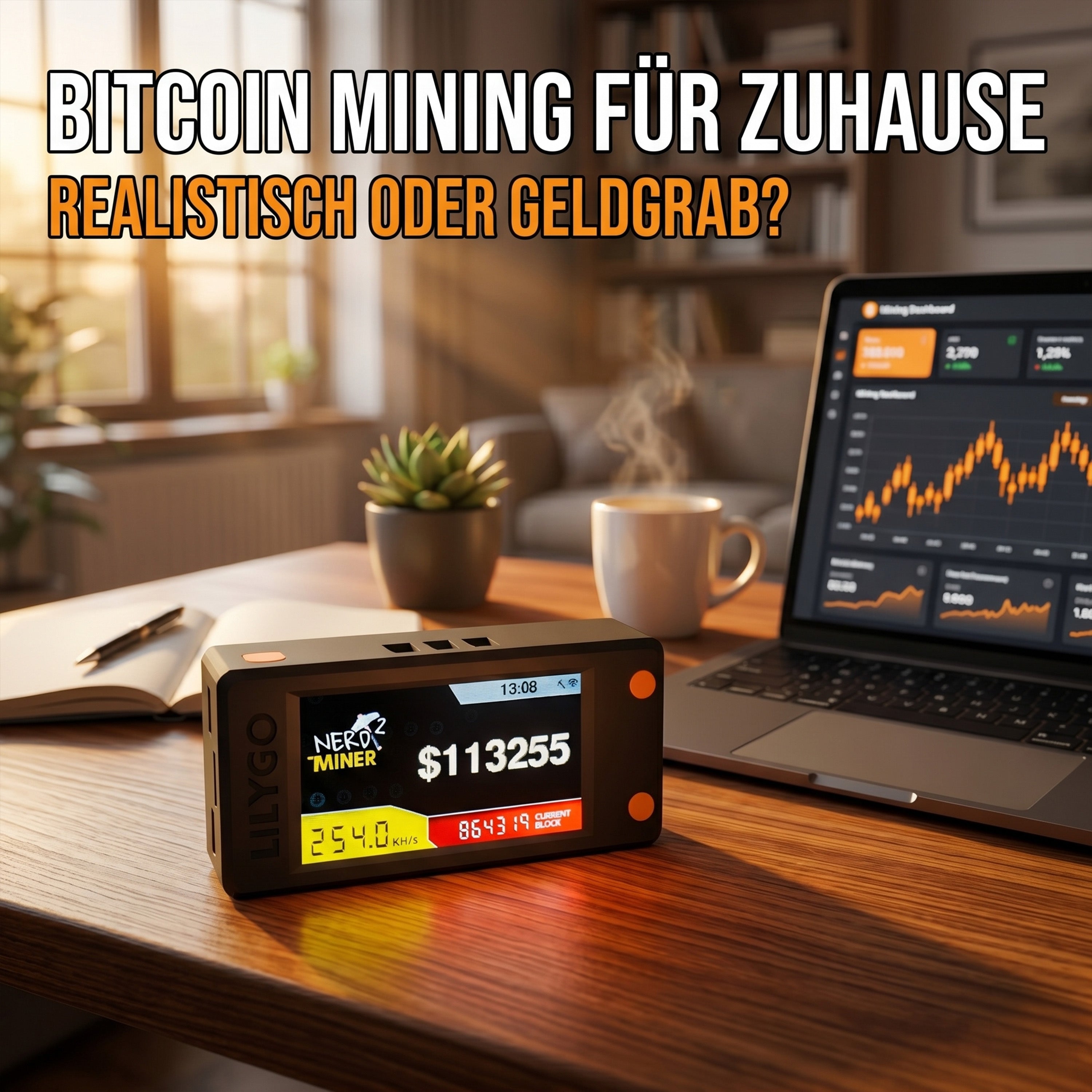
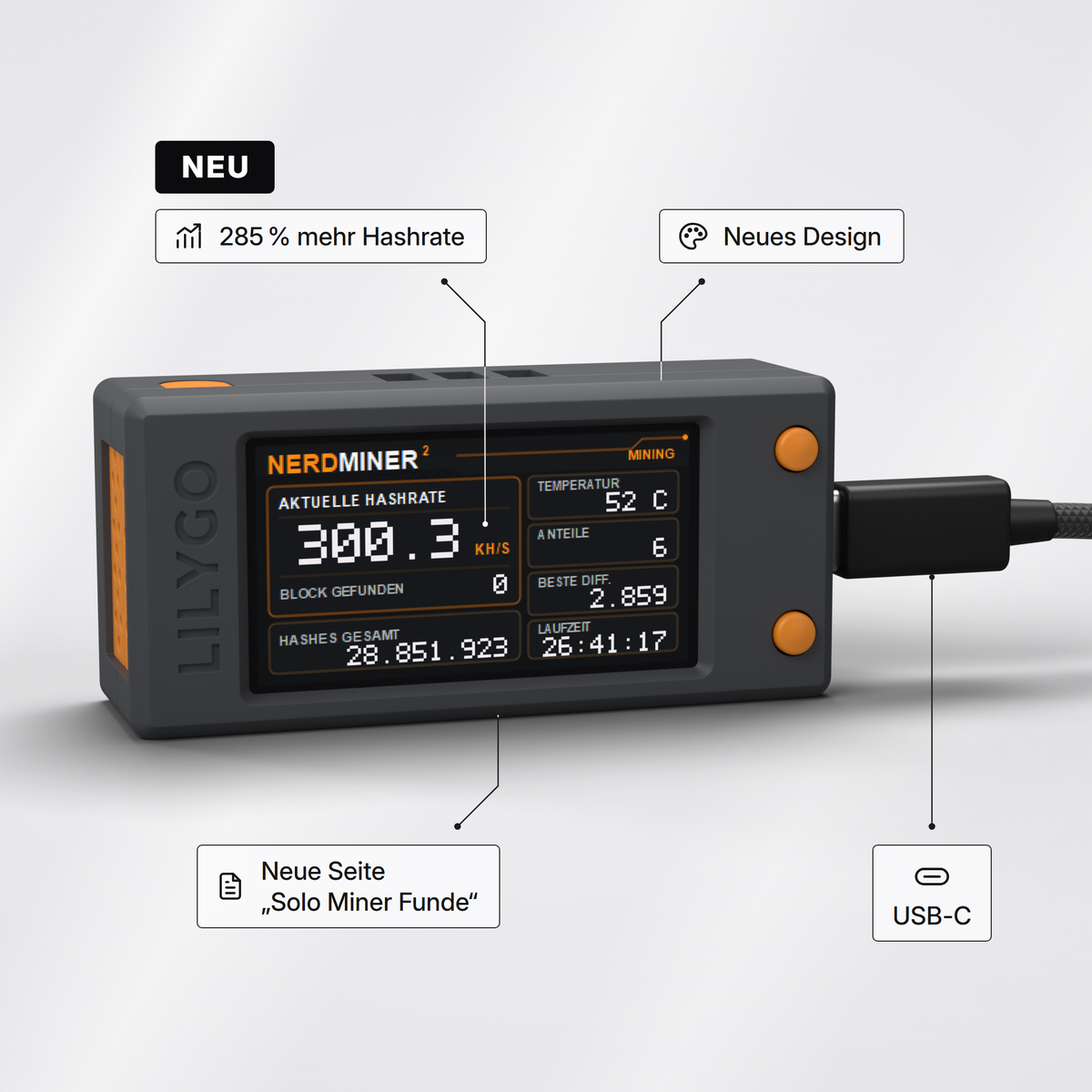
Mining at home is technically straightforward. The only question is which device. For the vast majority of households the right answer is a silent small miner like the Nerdminer V2 or the slightly stronger NerdNOS: a small outlay, real participation in the bitcoin network, barely any electricity. Large ASICs do not pay for themselves on normal household electricity; they only work out with solar surplus or industrial rates. Four things decide the choice: noise, heat, electricity and tenancy law. We go through all four honestly here.
To the Nerdminer V2 in the shop →"Can I mine bitcoin at home?" Thousands of people ask themselves that every year, and the answer is pleasingly clear: technically, mining bitcoin at home is entirely possible and open to anyone. Economically it only works out in special cases (solar surplus or industrial electricity); as an experience and a way to learn it works for everyone. This guide clears up the myths, is honest about noise, heat, running costs and tenancy law, and tells you what actually works in a typical living room, cellar or garage.
The three dimensions of home mining
Whether mining at home is possible does not depend on electricity price and hash rate alone. There are three often forgotten dimensions:
- Physical feasibility — noise, heat, wiring, space
- Economic sense — electricity price against expected returns
- Legal framework — tenancy law, neighbour law, owners' association
Any one of these can decide the matter even when the other two are fine. A BitAxe runs happily in a rented flat, but in a two-person flat with an open kitchen even its quiet fan grates over time. An Antminer S21 would be technically fine in the lonely cellar of a detached house, but on German household electricity it costs more than it earns. And so on.
Dimension 1: physical feasibility
Noise, the most underrated factor
Bitcoin miners differ dramatically in how loud they are. The levels:
-
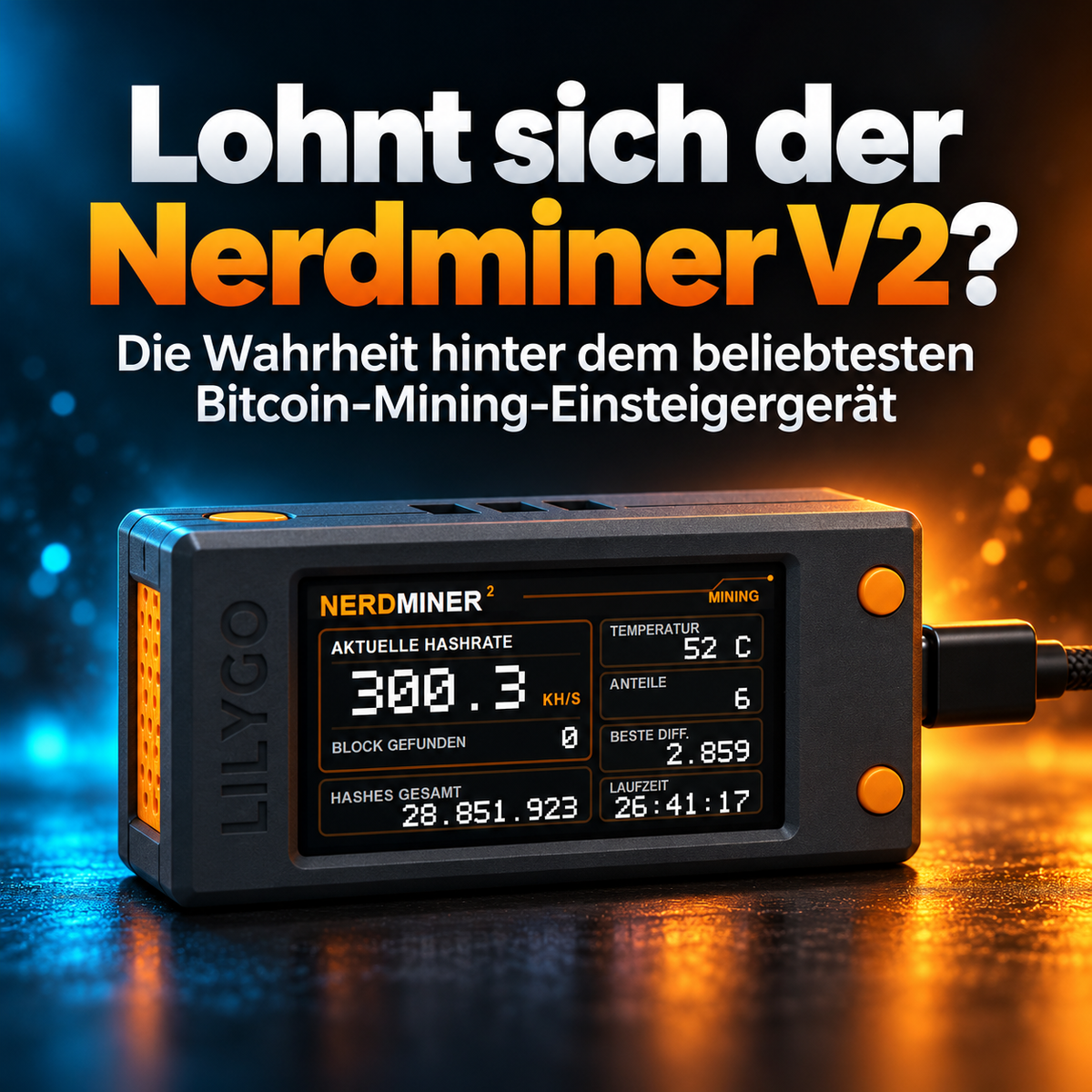
Nerdminer V2 and other ESP32-based small miners:
0 dB(completely silent) -
NerdNOS: around
42 dB(a quiet fan hum, like a calm desktop PC) -
BitAxe Gamma:
30–35 dB(a soft hum, like a quiet laptop) -
BitAxe Supra / OctaXe:
40–50 dB(clearly audible, like a desktop PC under load) -
Antminer S9 (legacy):
72 dB(like a powerful vacuum cleaner) -
Antminer S19/S21:
75–76 dB(constant noise, unbearable in a living space)
For context: 75 dB is the German legal limit for workplace noise without hearing protection. An Antminer in the living room makes conversation, films and sleep impossible. Even in a closed cellar the noise carries through the ceiling, and neighbours in a block of flats will notice.
The practical rule: below 40 dB → fine in a living space. 40–55 dB → separate room only, not where you live or sleep. Above 55 dB → garage, insulated cellar or an industrial site, not your living room.
Heat, the second challenge
Every watt a miner draws becomes heat. That is unavoidable physics: the chips' mathematical work ends up as thermal energy. What that means for your home:
- Nerdminer V2 (~1 W): imperceptible, like a phone sitting idle
- NerdNOS (~8 W): practically imperceptible; at most the case itself gets warm
- BitAxe Gamma (15 W): around 12,000 BTU a year, a small room gets slightly warmer
- Antminer S19 (3,100 W): like a fan heater permanently on its highest setting; a 20 m² room would be uninhabitable in summer
- Antminer S21 (3,500 W): more still, you need active cooling or extraction for the whole room
In winter that heat can take some load off your heating. With a 3,500 W machine in the cellar of a detached house you save perhaps €30–80 a month in heating, which you can set against the mining cost. In summer it is exactly the other way round: you have to cool the heat away, which costs electricity again, usually another 30 to 50 % on top of what the miner draws.
Wiring and connection
German households are built around 230 V sockets on 16 A circuits. That means roughly 3,680 watts of continuous load per socket. A single Antminer S21 at 3,500 watts occupies almost that entire capacity, and you cannot run anything else on that circuit. Two Antminers on the same circuit would trip the breaker immediately.
Larger setups need dedicated 16 A circuits or even three-phase (400 V) connections. That is an electrician's job, not DIY. Installation costs €300–800 and needs your landlord's approval if you rent. Small miners, by contrast, plug into any ordinary socket.
Space
Small miners need the area of your palm. Professional miners need roughly a shoebox plus 30 cm clearance all round for airflow. In a typical 60 m² flat you might still find a corner for an Antminer, but you have to live with the noise, the heat and the cabling.
Dimension 2: does it make economic sense?
The arithmetic is simple: monthly electricity must not exceed what mining brings in. In Germany at €0.32/kWh it looks like this:
| Device | Monthly electricity | Monthly return (pool) | Monthly result |
|---|---|---|---|
| Nerdminer V2 (~1 W) | €0.23 | ~€0.00 | -€0.23 |
| NerdNOS (~8 W) | €1.84 | ~€0.00 | -€1.84 |
| BitAxe Gamma (15 W) | €3.50 | €2.80 | -€0.70 |
| Antminer S9 (1,300 W) | €305 | €45 | -€260 |
| Antminer S17 (2,500 W) | €587 | €85 | -€502 |
| Antminer S19j Pro (3,100 W) | €728 | €130 | -€598 |
| Antminer S21 (3,500 W) | €821 | €195 | -€626 |
The pattern is unmistakable: the bigger the miner, the higher the monthly cost at German household prices. Large ASICs cost more than they earn on household electricity. Small miners, on the other hand, cost cents a month. That is the modest entry fee for taking part and learning, not a loss that hurts.
The exception: your own solar power
There is one situation in which home mining with professional hardware can work out: if you have your own solar array producing more during the day than you use. Instead of feeding the surplus into the grid at 6 to 8 cents per kWh, you can put it into bitcoin mining.
Worked example with a 10 kWp array: on sunny days you have roughly 5 to 7 kWh of surplus per hour, on cloudy ones 1 to 3 kWh. An Antminer S21 drawing 3.5 kW can consume that surplus instead of exporting it. Since the export tariff is around 7 cents/kWh, the effective mining electricity price becomes 7 cents rather than 32, and the economics move into the green. The condition: the miner only runs during the day when there is surplus, which means the machine stands idle 60 to 70 % of the time, which in turn lowers the mining return accordingly.
A realistic break-even: at the current BTC price and difficulty an Antminer S21 needs an effective electricity price below €0.07/kWh. A solar array reaches that only at certain times of day, with a good roof angle and little self-consumption. The calculation is fiddly and individual.
Dimension 3: the legal framework
Tenancy law
As a tenant in Germany you are in principle free to run devices in your flat, as long as they do not disturb the other tenants and require no structural changes. But:
-
Noise: devices above
40 dBrunning at night can count as an unreasonable disturbance under the house rules and neighbour law. An Antminer at75 dBis clearly above that. - Structural work: the moment you have a new circuit, an extraction opening or air conditioning installed, you need the landlord's consent.
- Heavy consumption: in rented flats with shared hot-water or heating billing, a permanent extra 3,000 kWh a month will be noticed and can raise legal questions.
For small miners (Nerdminer V2, NerdNOS, BitAxe Gamma) none of this applies. They are unproblematic in any ordinary rented flat.
Owned flats
In a German owners' association similar rules apply: nothing that requires structural change may happen without the association's consent. Noise limits are often enforced more strictly than under tenancy law.
Neighbour law
Even in your own house: if your miner's noise carries into the neighbouring houses, you can face an injunction. German immission control law sets quiet hours (22:00 to 06:00) during which noise levels of 35–40 dB at the neighbour's window must not be exceeded.
What to run, by scenario
Typical rented flat (2 to 3 rooms)
Suitable: Nerdminer V2, several Nerdminers together, GekkoScience USB miners. Anything silent that draws under 5 W, which means bedroom-friendly.
Not suitable: BitAxe Supra or larger, any Antminer model.
Detached house with a cellar
Suitable: Nerdminer V2, NerdNOS (around 42 dB, ideal for a separate room or cellar), BitAxe Gamma, BitAxe Ultra. Used Antminer S17s with noise damping are possible but not economic.
Not suitable: Antminer S19/S21 on normal household electricity, it does not pay off.
Detached house with solar surplus
Suitable: every class including the Antminer S21, as long as the miner only runs on surplus. Needs smart control (through Home Assistant, for example) that switches the miner on and off with the solar yield.
Garage or commercial unit
Suitable: everything, provided the power, noise and cooling conditions are met. The ideal location for serious home mining.
The simplest way to start
To begin you need only the small miner and a bitcoin address of your own. We recommend a free account at eToro (EU regulated), where you'll find your receive address in the eToro wallet. Prefer a wallet that only you control? Then Tangem, 10% off through our link. Enter the address in the miner and you are mining as a fully fledged solo miner straight away.
Open a free eToro account →eToro risk warning: Your capital is at risk. Crypto assets are highly volatile, other fees and taxes may apply.
The realistic conclusion
For roughly 95 % of German households, "bitcoin mining at home" means hobby mining in miniature. A Nerdminer V2 on the desk, working silently and drawing almost nothing, or a slightly stronger NerdNOS in a separate room: that is the realistic version, open to anyone. Anything beyond it needs industrial electricity, a solar array with a large surplus, or a conscious decision to lose money on professional hardware.
The good part: even in miniature you learn every important concept through home mining (hash rate, difficulty, pool, block reward), you see live data on a display, and you take part in the bitcoin network as a full solo miner. The educational and emotional side is worth every cent. And the lottery appeal is real: if your small miner happens to find a block, the entire reward of 3.125 BTC, around €195,000, is yours. The chance is tiny, but it is genuine, and the stake is cents a month.
Start mining at home, quietly and within anyone's reach
The Nerdminer V2 is the silent way in for any flat. The NerdNOS adds noticeably more hash rate at around 100 GH/s, ideal for a separate room or a cellar.
To the Nerdminer V2 → To the NerdNOS → Quiet, frugal, ready to run — the honest route into home mining.Common questions about mining bitcoin at home
How much do you earn mining bitcoin at home?
With a small miner (Nerdminer V2, NerdNOS) it is essentially a lottery costing cents: ongoing returns of practically zero, but a genuine chance of finding a whole block (3.125 BTC, around €195,000) with some luck, at cents of electricity a month. With a BitAxe: €2–5 a month gross, usually slightly negative once electricity is deducted. An Antminer on German household electricity costs more than it earns; it only becomes profitable with solar surplus or cheap industrial power. Home mining is mainly there for learning and taking part, not as a reliable income.
Do you need a permit to mine bitcoin at home?
No. Bitcoin mining is legal in Germany and needs no permit. The only legal limits come from tenancy law, neighbour law and, at higher earnings, tax obligations.
Can you mine profitably with solar power?
Yes, under certain conditions. A solar array with regular surplus that would otherwise be exported at around 7 cents per kWh drastically lowers the effective mining electricity price. An Antminer S21 that only runs on surplus can be profitable in that case.
How much heat does a bitcoin miner produce?
Room temperature rises in proportion to the device's electrical power. Rule of thumb: 1,000 watts is roughly 3 to 5 °C of warming in a 15 m² room with normal ventilation. A 3,500 W Antminer can heat that room by 8 to 12 °C within 2 to 3 hours. A small miner drawing a few watts is thermally imperceptible.
What happens if the wiring is too weak?
The breaker trips. In extreme cases an overloaded, under-dimensioned cable can overheat, which is a fire risk. For anything above 2,000 W of continuous load an electrician should always check the wiring or install a dedicated circuit. Small miners are entirely uncritical here.
Read on in the Nerdminer guide:
- Bitcoin mining for beginners, the basics
- Buying a bitcoin miner, all four classes
- Measuring power draw, what a Nerdminer really uses
- NerdNOS power draw, what the stronger small miner uses
- Nerdminer V2 vs NerdNOS, which one suits you?
- Setting up the NerdNOS, step by step
- Tax on mining income in Germany
- Nerdminer V2 review, 12 months of home mining
eToro risk warning (advertising): eToro is a multi-asset platform which offers both investing in stocks and trading CFDs. CFDs are complex instruments and come with a high risk of losing money rapidly due to leverage. 50% of retail investor accounts lose money when trading CFDs with this provider. You should consider whether you understand how CFDs work and whether you can afford to take the high risk of losing your money. Crypto investments are high risk and highly volatile. Crypto trading at eToro (Europe) Ltd. is provided by DLT Finance, crypto custody by Tangany. Taxes may apply. Your capital is at risk. We earn a commission on accounts opened through the eToro links on this page.


Teilen: