
Short answer
Crypto mining in 60 seconds
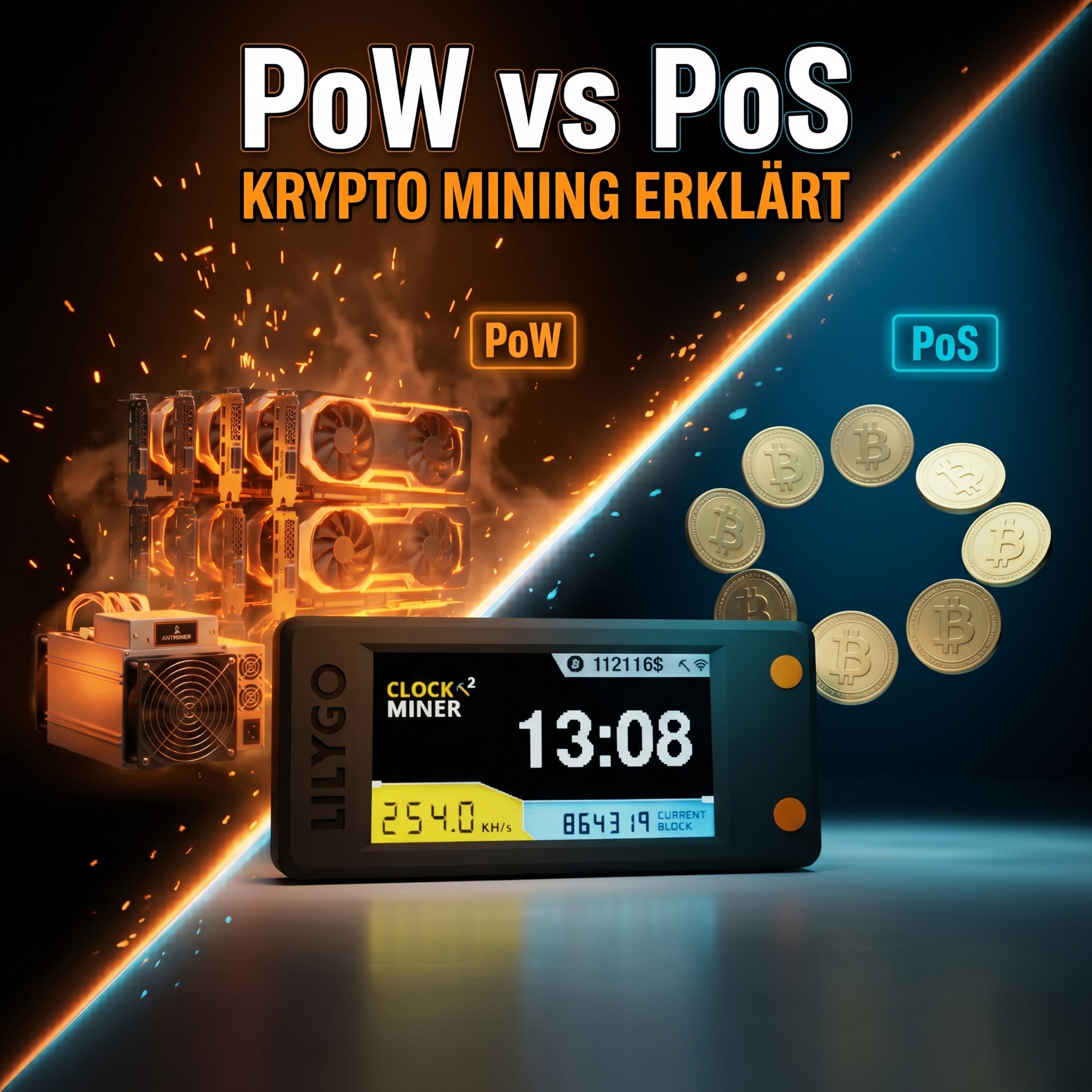
Crypto mining means computers secure a blockchain network through real computational work and are rewarded with new coins for it. That only applies to proof of work (bitcoin, for instance). Its modern counterpart proof of stake (Ethereum) replaces computation with pledged capital, and that is called staking, not mining. Rule of thumb: mining is for hardware people, tinkerers and anyone who wants to experience the network first hand; staking is for capital-minded investors after a passive return without hardware.
People who say "crypto mining" usually think of bitcoin. But the term covers a whole spectrum: from classic proof-of-work mining as bitcoin uses it, through variants with CPU-friendly or ASIC-resistant algorithms, to modern consensus mechanisms like proof of stake where mining does not happen at all. This article explains the differences between the main consensus mechanisms in 2026, shows which coins still allow real mining, and answers the central question: mining or staking, which is actually worth it?
What is crypto mining?
Crypto mining describes the process by which new transactions on a blockchain network are confirmed and anchored in blocks while computers perform work. The mechanism governing that is called the consensus method. There is more than one; different cryptocurrencies use different methods depending on the design decisions of their founders.
"Mining" in the narrow sense refers only to consensus methods in the proof-of-work family, where real computation is performed. Modern methods such as proof of stake strictly speaking are not mining; there the process is called staking or validating. The distinction matters, because it brings completely different hardware, costs and reward models.
Proof of work, classic crypto mining
Proof of work (PoW) is the oldest consensus method. Bitcoin introduced it in 2008 and numerous other coins adopted it. The basic principle:
- Miners collect pending transactions and bundle them into a block
- They try to find a mathematical value meeting certain conditions (typically a hash with a given number of leading zeros)
- Whoever finds the solution first gets to record the block and receives the reward
- The rest of the network verifies the solution and accepts the block
The "work" is genuine physical work: electricity, heat, wear on the hardware. That makes proof of work energy intensive but also extremely secure. An attacker would need more computing power than the honest network to manipulate the chain, which for bitcoin currently means an investment in the tens of billions.
Well-known proof-of-work coins
-
Bitcoin (
BTC) — SHA-256, ASIC dominated, the largest PoW network in the world -
Bitcoin Cash (
BCH) — SHA-256, a smaller fork, merge mining possible -
Litecoin (
LTC) — Scrypt, merge mined with Dogecoin -
Dogecoin (
DOGE) — Scrypt, runs alongside Litecoin -
Monero (
XMR) — RandomX, CPU friendly, ASIC resistant -
Kaspa (
KAS) — kHeavyHash, a BlockDAG rather than a classic blockchain -
Ravencoin (
RVN) — Kawpow, the GPU standard -
Ergo (
ERG) — Autolykos v2, ASIC resistant
Proof of stake, the modern counterpart
Proof of stake (PoS) was developed as an environmentally friendlier alternative to mining. Instead of computation, PoS requires participants to pledge their own coins as security ("staking"). The more you stake, the higher your chance of being selected as the next validator and receiving a reward.
The decisive difference: with PoW you supply work, with PoS you supply capital. A validator needs no ASIC chip and no 3,500 W power supply, only a decent server, a stable internet connection and the required minimum stake in that cryptocurrency.
Well-known proof-of-stake coins
-
Ethereum (
ETH) — PoS since "the Merge" in September 2022, a minimum of 32 ETH for your own validator -
Cardano (
ADA) — an Ouroboros variant, no minimum stake for delegation -
Solana (
SOL) — proof of history plus stake, high staking participation -
Polkadot (
DOT) — NPoS (nominated PoS), nominating validator groups -
Cosmos (
ATOM) — Tendermint BFT, interchain consensus -
Avalanche (
AVAX) — Snowman consensus, a particular PoS variant
The decisive differences between mining and staking
| Criterion | Mining (PoW) | Staking (PoS) |
|---|---|---|
| Entry cost | Hardware (€50 – €5,500) | A coin stake (often four figures) |
| Running cost | Electricity (can be hundreds of € a month) | Hosting and maintenance (low) |
| Source of return | Block reward when a block is found | Staking rewards, often 3–8 % a year |
| Risk of loss | Hardware failure, power cuts | Slashing (penalties for misbehaviour) |
| Environmental profile | Energy intensive | Very low (a fraction of PoW) |
| Technical knowledge | Hardware understanding, firmware upkeep | Server understanding, wallet management |
| How small you can start | Possible from €50 of hardware | Often a minimum stake (32 ETH, say) |
Hybrids and oddities
Alongside classic PoW and PoS, 2026 still has numerous mixed forms and special variants:
- Proof of less work (PoLW) — Alephium uses this variant, combining PoW with reduced energy use
- Proof of history (PoH) — Solana uses a cryptographic timestamp combined with PoS
- Proof of space / proof of capacity — Chia uses disk storage rather than CPU to "farm" plots (also called storage mining)
- Proof of authority (PoA) — a centralised variant with a fixed set of known validators, mainly in private blockchains
- Proof of burn (PoB) — participants must burn coins (send them to an unspendable address) to earn mining rights. Barely used in practice.
What can you still mine today?
The mining scene of 2026 has consolidated heavily against the gold-rush era of 2017 to 2021. After Ethereum moved to PoS in September 2022, billions of euros of GPU mining hardware were freed up for bitcoin alternatives. The options that still make sense:
- Bitcoin — with ASICs; built for earnings only with cheap industrial power or solar surplus
- USB solo mining with a Nerdminer V2, a NerdNOS or a BitAxe — as a learning and lottery project to follow along with: real solo mining you can touch, for a small outlay
- Litecoin and Dogecoin merge mining — with ASICs such as the Antminer L7, mainly on industrial power
- Monero CPU mining — not built for earnings, but maximally decentralised and philosophically appealing, and it runs on ordinary hardware at home
- Kaspa and Alephium — young, highly volatile, workable at home on smaller devices
- Ravencoin, Ergo — GPU mining, economically marginal
What you can no longer mine: Ethereum, Solana, Cardano, Polkadot, Cosmos, Avalanche, Binance Smart Chain (BSC), Polygon and nearly every other large "layer 1" project of recent years. They have chosen PoS or use entirely different mechanisms.
Mining or staking, which is better?
The answer depends on your goal:
You want to own bitcoin
For simply owning bitcoin, buying directly on an exchange is cheaper than mining in the vast majority of cases. Straightforward and EU regulated, that works at eToro, for example. Mining is worth it for ownership mainly when you have access to industrial power or solar surplus.
Would you rather just buy bitcoin?
If all you want is to own bitcoin, buying directly saves you hardware, electricity and maintenance. We recommend eToro for that, an EU-regulated platform with a free account.
Buy bitcoin at eToro →You want a passive return on crypto holdings
Staking. 3 to 8 % a year on ETH, SOL, ADA or ATOM is realistic, with no electricity and no hardware. The exact return depends on the coin and the network and is not guaranteed.
You want to learn and experience mining technology
A small miner (Nerdminer V2 or NerdNOS). A small outlay, plug and play, a live display, a shared community moment: real solo mining for learning, with a small but genuine block chance as the thrill. You follow every hash without having to run a mining farm.
You want to take part in the bitcoin network professionally
A mining farm with industrial power or your own solar array. From roughly €50,000 upwards, with a predictable return in the right electricity environment.
You want maximum decentralisation and privacy
Monero mining on a modern AMD CPU. Not built for earnings, but ideologically consistent and workable at home on ordinary hardware.
The future: will mining become obsolete?
Since Ethereum's move to PoS in 2022 there has been recurring debate over whether bitcoin will eventually follow. The bitcoin community's answer is close to unanimous: no. Proof of work is not merely an energy consumption mechanism, it is the heart of bitcoin's security architecture. A move to PoS would fundamentally change the rules, and a large part of the community sees that as a betrayal of Satoshi's vision. Every serious proposal to move bitcoin to PoS has been blocked.
Bitcoin mining will therefore continue to exist in 2026 and beyond. The question is not whether, but where and with which energy mix. The trend towards renewables is unmistakable: according to a University of Cambridge study (CCAF, 2025) around 52 % of global bitcoin mining energy now comes from sustainable sources (renewables plus nuclear), and the share is rising.
Common questions about crypto mining
Can I mine crypto with my PC?
With a modern CPU or GPU you can in theory mine altcoins such as Monero (CPU) or Ravencoin (GPU). Bitcoin on ordinary PC hardware is not built for earnings. For Monero, current AMD Ryzen CPUs manage 20 to 30 kH/s, which is worth a few cents a day and is more a contribution to decentralisation than a source of income.
Is crypto mining taxable in Germany?
Yes. Mining income counts as other income under § 22 no. 3 of the German income tax act, with an exemption threshold of €256 a year. Details: bitcoin mining tax in Germany.
Which is better, mining or staking?
Neither, it depends on your goal. Mining is better for hardware enthusiasts, learners and hobbyists. Staking is better for capital-minded investors who want a passive return without hardware.
Why is bitcoin still mined if it uses so much energy?
Because the energy use is not a bug, it is the feature. Bitcoin's security depends directly on mining being hard. A more efficient bitcoin would also be a less secure bitcoin. The community accepts that trade-off deliberately, particularly as the share of sustainable energy in mining keeps rising.
Can I still mine Ethereum?
No, not since September 2022. Ethereum switched to proof of stake with "the Merge". ETH mining hardware (GPUs above all) can only be used for other coins now, such as Ravencoin, Ergo or Flux.
Read on
Experience mining yourself
Get into real bitcoin solo mining with the Nerdminer V2: a small outlay, plug and play, a live display to follow along with. If you want more hash rate and a genuine ASIC experience, take the NerdNOS.
To the Nerdminer V2 → or the ASIC experience: the NerdNOS high-speed Nerdminer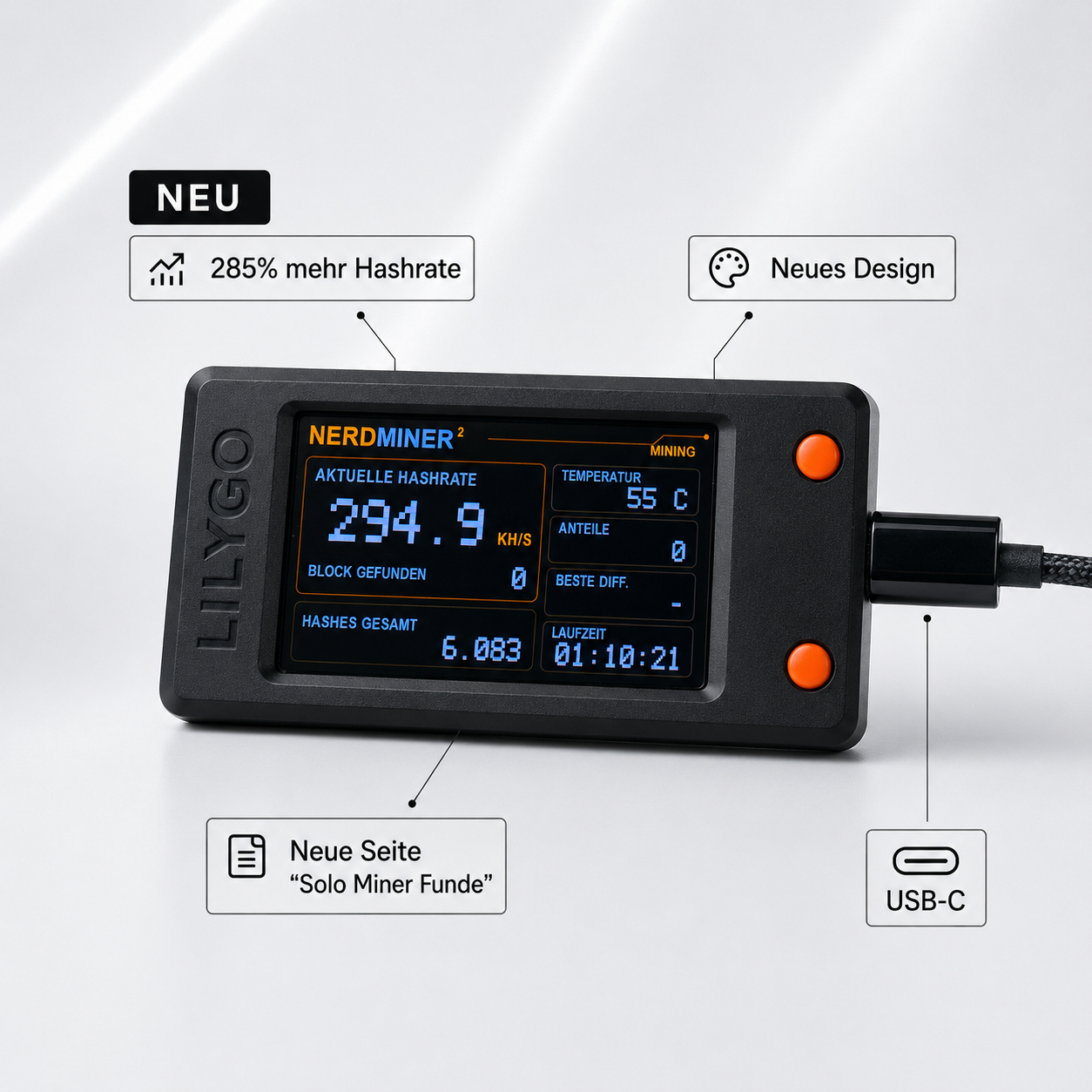


Teilen: