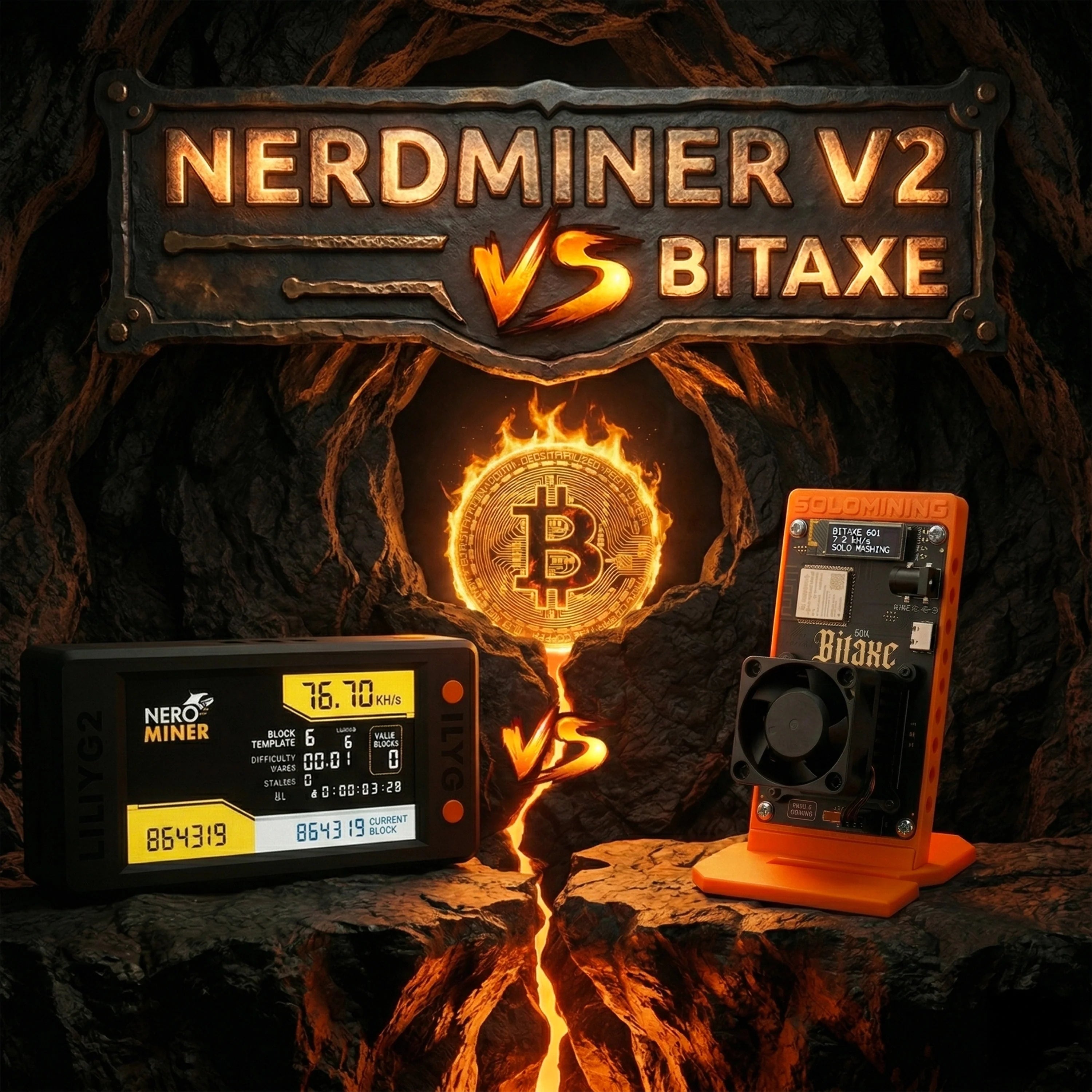
Nerdminer V2 vs. BitAxe — When is the Surcharge for the Open-Source Heavyweight Worth It?
Both devices are open-source solo miners. Both come from the Bitcoin community, not from commercial mining companies. Both aim to enable you to find a real Bitcoin block with your own hardware. But the differences between the Nerdminer V2 (€49, 250 KH/s) and the BitAxe (€150-250, 1 TH/s) are so significant that the question "which is better?" depends on your purpose. This comparison goes into detail: hash rate mathematics, power consumption, setup effort, community support, and the honest answer to when the 3x surcharge is actually worth it.
Comparison at a Glance
| Criterion | Nerdminer V2 (T-Display S3) | BitAxe Gamma (601) |
|---|---|---|
| Price | €48.99 – €64.99 | €150 – €200 |
| Hashrate (Stock) | 230 – 250 KH/s | 0.9 – 1.1 TH/s |
| Chipset | ESP32-S3 (not a true mining ASIC) | BM1366 (true Bitcoin ASIC) |
| Power Consumption | < 1 W | 12 – 16 W |
| Annual Electricity Costs (0.32 €/kWh) | ~ €2.80 | ~ €36 – €45 |
| Volume | completely silent | small fan, audible |
| Display | OLED with Live Stats | no display, LED status |
| Setup Complexity | Plug & Play (3 min) | Firmware flash required (15-30 min) |
| Mining Chance per Block (Solo) | 1 : 47,500 years | 1 : 12 years |
The Decisive Difference: ESP32 vs. True ASIC
The most important technical difference — which explains the 4,000-fold jump in hash rate — lies in the chipset. The Nerdminer V2 uses an ESP32-S3, a microcontroller originally developed for IoT applications. SHA-256 hashing is one of many tasks that the ESP32 performs on the side — and accordingly slowly.
The BitAxe Gamma, on the other hand, has a BM1366 on board, a true Bitcoin mining ASIC that comes directly from Antminer S19 Pro devices. A single BM1366 is optimized for SHA-256 and delivers around 1 TH/s — that's 4,000 times more hash attempts per second than the ESP32 in the Nerdminer.
Practically, this means: The Nerdminer V2 is an educational device with symbolic mining functionality. The BitAxe is a true mini-ASIC that, in solo mode, has a statistically relevant (though still low) chance of finding a block.
The Hash Rate Mathematics
With the current Bitcoin network hash rate of around 620 EH/s, the following statistical success waiting time in solo mining results:
- Nerdminer V2 with 250 KH/s → ~47,500 years until the average block
- BitAxe Gamma with 1 TH/s → ~12 years until the average block
The difference seems enormous in everyday life, but it remains mathematical: neither with the Nerdminer nor with the BitAxe is a block find plannable. There were Nerdminer users who got lucky after a few months. There were BitAxe users who found nothing after 3 years. Mining is a Poisson-distributed random lottery — "12 years" does not mean "I will find a block in 12 years", but "the expected average waiting time is 12 years".
Power Consumption — The Hidden Cost Factor
For the Nerdminer V2, power consumption is so low that it can be economically ignored: around €2.80 per year for continuous operation at the German household electricity price of €0.32/kWh.
For the BitAxe, it's different: 12-16 watts mean around 100-140 kWh per year in continuous operation, i.e., €32-45 in electricity costs annually. Over the typical lifespan of a BitAxe of 3-5 years, electricity costs add up to €100-€225. With a purchase price of €150-€200, this means a doubling of total costs.
Important in this calculation: The BitAxe has a 12-year statistical block expectation time, but the total electricity costs are purely fixed. Without an actual block find, the BitAxe burns money. The Nerdminer V2 burns practically nothing.
Setup and Daily Use
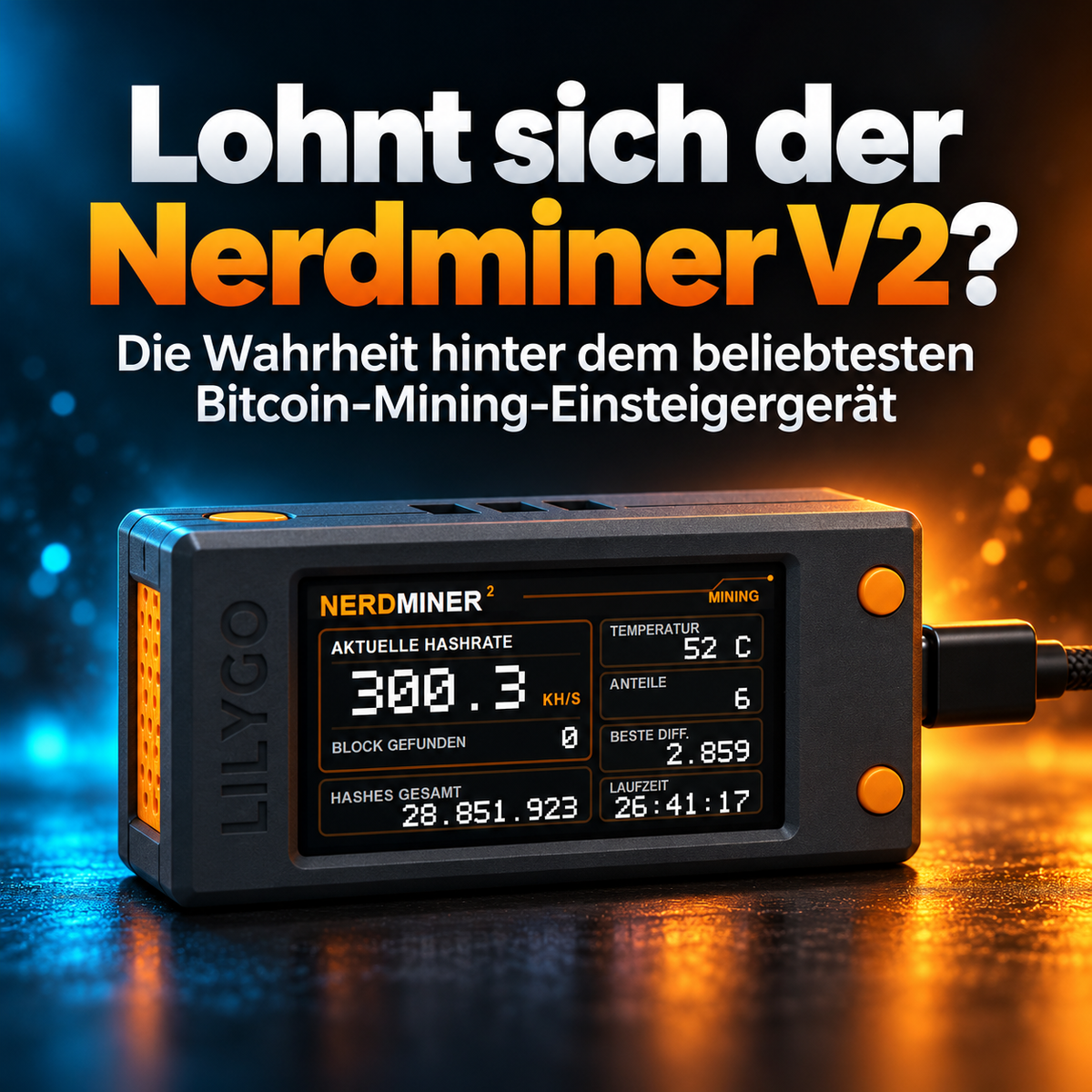
Nerdminer V2 is Plug-and-Play in the truest sense: plug in USB, connect to setup Wi-Fi, enter Bitcoin address, done. 3 minutes. The OLED display shows live hash rate, shares found, current block, and price information.
BitAxe Gamma is a significantly different process. You typically get a board and a case — some variants you have to assemble yourself. The firmware (AxeOS or ESP-Miner) is flashed via USB. Then comes network configuration via a web interface, entering the pool URL, connecting the power supply (either 5V USB-PD or 12V power adapter). Total setup time: 15-30 minutes, sometimes 1 hour for beginners.
In daily use: The Nerdminer sits on the desk, displays its screen, is completely silent. The BitAxe is also clearly visible, but has a small fan that is audible (comparable to a laptop fan under moderate load) and an LED status field that signals the current hash rate — but no nice live display like the Nerdminer.
Community and Firmware Maintenance
The Nerdminer V2 has a larger and more active community. The official NerdMiner_v2 firmware on GitHub receives regular updates (1.6.x → 1.7.x → 1.8.3), there are German and English tutorials, an active Discord server, and numerous YouTube guides.
The BitAxe has a smaller but technically savvy community. The firmware variants (AxeOS, ESP-Miner) are maintained less regularly, and support primarily runs through Discord and English Reddit threads. If you have a problem, it's less likely that someone has already documented a German solution.
When Is the BitAxe Really Worth It?
The honest answer to the core question of this comparison:
- If you want a BitAxe as a "real mini-Bitcoin miner with a realistic block chance" — yes, it's worth it. The 12-year expectation is mathematically in a completely different league than 47,500 years.
- If you want to make mining technology tangible and enjoy live data — no, the Nerdminer V2 is better for that. The OLED display is more educationally valuable than a BitAxe LED strip.
- If you already have experience with mining hardware and firmware flashing — BitAxe is more fun because you can adjust and optimize more.
- If you are looking for a gift — Nerdminer V2, definitely. Plug & Play, live display, no setup frustration.
- If you have a budget of €150, you are better off with two Nerdminers (combined hash rate 500 KH/s) than with an expensive-to-operate BitAxe.
The Real Alternative: Have Both
Many experienced solo miners have both: a Nerdminer V2 for the desk display and community aesthetic, plus a BitAxe for the statistically more realistic block chance. With a single Bitcoin address that both devices mine to, the hash rates add up — and the mathematical expected value improves accordingly.
Frequently Asked Questions About the Comparison
Can I run a BitAxe with NerdMiner firmware?
No. The NerdMiner firmware runs on an ESP32-S3 without a true ASIC chip. The BitAxe has a BM1366 ASIC, which requires a completely different software interface. The two ecosystems are not compatible.
Which device has lasted longer?
The Nerdminer V2 is the newer standard and has only existed since 2022/2023. The BitAxe has a slightly longer history with several generations (Ultra, Gamma, Supra). Both devices are designed for 5-10 years of continuous operation under normal conditions, as long as cooling is ensured.
Which is safer against "bricking"?
The Nerdminer V2 — because its firmware updates run via a web flasher that has a recovery mode. The BitAxe can be more difficult to reanimate in case of an incorrect firmware flash or hardware crash, especially without soldering equipment.
Can I power the BitAxe with a USB power adapter?
Only the Gamma (and only with USB-PD-enabled power adapters that deliver at least 15 watts at 5V). The stronger BitAxe variants (Supra, OctaXe) require an external 12V power adapter.
Which is better for beginners?
Clearly the Nerdminer V2. Lower entry barrier, better documentation, no setup frustration, lower price, lower risk of errors.
Conclusion
The Nerdminer V2 is the better beginner device, the better gift, the better desk gadget, and the more economically sensible hobby mining setup. The BitAxe is the better "real solo mining" device, the better hobbyist project, and the better step if you want to grow out of the mini format. Both are open-source community projects, both genuinely participate in the Bitcoin network — they just answer different questions.
Further Reading
- Buying a Bitcoin Miner 2026 — The Complete Buyer's Guide
- Nerdminer V2 Alternatives — 7 Mini-Miners Compared
- Nerdminer vs. Antminer — The Extreme-Class Comparison
- Nerdminer V2 vs. NerdNOS — Same Hardware, Different Firmware
- Bitcoin Solo Mining Practical Guide
Order Nerdminer V2
Nerdminer V2 in the shop — from €48.99 with free shipping
To the Nerdminer V2 in the shop →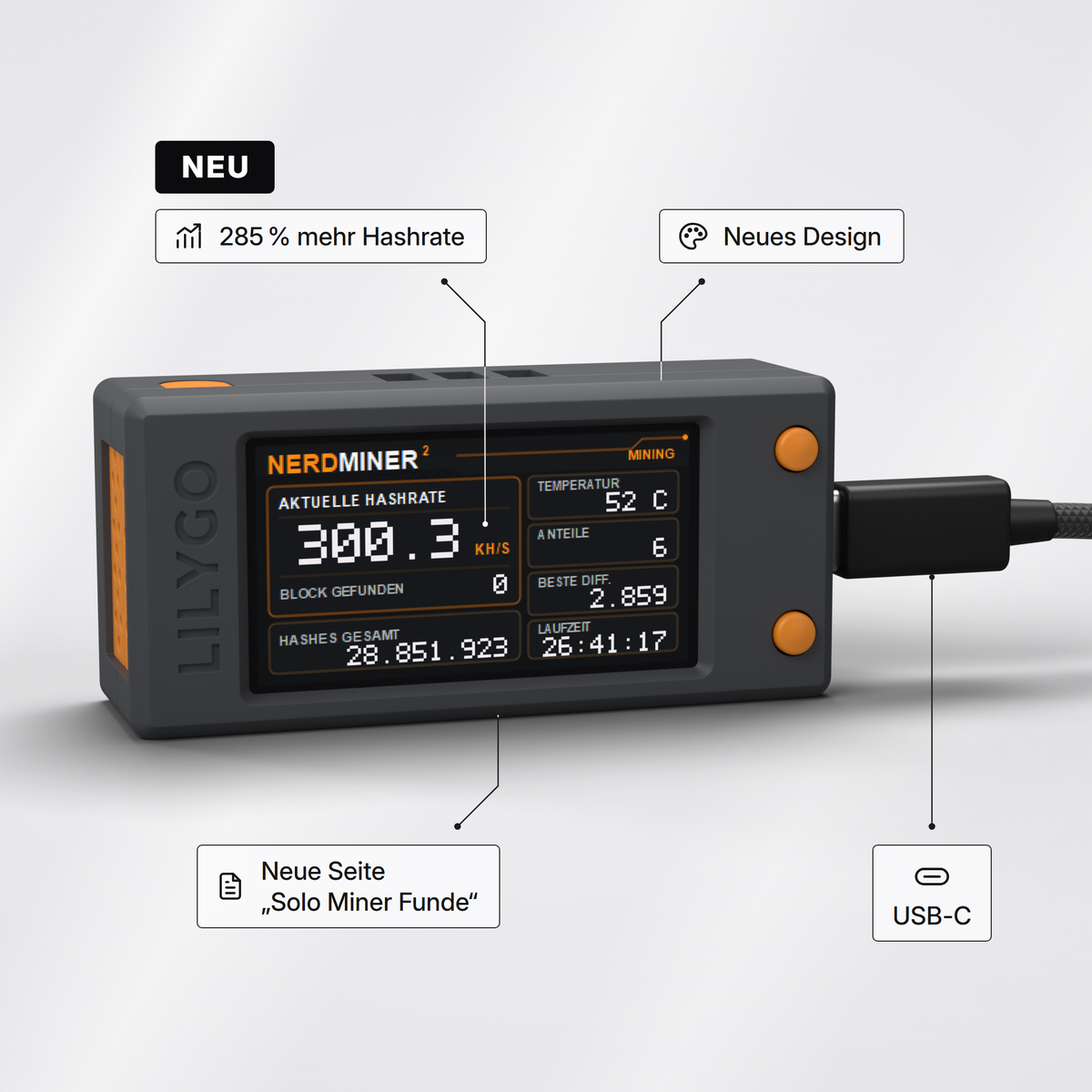


Teilen: