

Bitcoin Mining for Beginners 2026 — How Bitcoin's Backbone Works
For many, Bitcoin Mining conjures images of gigantic industrial halls, loud fans, and huge electricity bills. Sometimes, it is precisely that. But mining is much more: It is the mechanism that makes Bitcoin function at all — without banks, without a central authority, without reliance on a third party. This guide explains what Bitcoin mining truly is, how it technically works, who operates it today, and what role mining plays for the entire Bitcoin economy — without marketing fluff, but at a level you can understand even without a computer science degree.
What is Bitcoin Mining?
Bitcoin mining is the process by which new Bitcoin transactions are confirmed, bundled into a block, and irreversibly written to the Bitcoin blockchain. Miners — the computers that perform this process — fulfill three key tasks:
- Verify transactions: Each miner checks whether a submitted transaction is valid (correct signature, sufficient balance, no double-spending).
- Create blocks: Valid transactions are bundled into a new block — approximately one block every 10 minutes.
- Secure the network: By using real computing power, manipulation becomes computationally almost impossible. Anyone who wanted to manipulate the Bitcoin blockchain would have to control more than half of the world's mining power — an investment in the tens of billions.
As a reward for this work, the successful miner receives two things: the block reward in the form of newly created Bitcoin (currently 3.125 BTC per block, halving every 4 years — the next halving is due in 2028) and all transaction fees of the transactions in the block. At the current Bitcoin price, this is roughly 190,000+ Euros equivalent per block found.
Proof of Work — The Game Behind Mining
Bitcoin uses the so-called Proof of Work mechanism. Imagine it as a giant, worldwide dice game: Each miner rolls the dice as often as they can until they roll a number smaller than a certain target value. Whoever finds this number first gets to write the next block and collects the reward.
Instead of actual dice, Bitcoin uses the SHA-256 hash algorithm. The miner changes a tiny variable (the "nonce") in each attempt, calculates a hash from it, and checks if the hash is below the target value. On average, trillions of attempts are needed for this — per block. This is precisely why Bitcoin requires so much energy.
Difficulty Adjustment — The Self-Stabilizer
What makes Bitcoin so ingenious: The difficulty of this dice game adjusts automatically. Every 2,016 blocks (approximately every two weeks), the network calculates whether blocks were found too fast or too slow on average in the past period. If it was too fast, the difficulty is increased. If it was too slow, it is decreased.
The result: No matter how much mining power is added or shut down worldwide — on average, a new block is generated every 10 minutes. This was planned, has been stable since 2009, and is one of Satoshi Nakamoto's most important inventions.
Hashrate — The Unit of Mining Power
The Hashrate measures how many hash calculations a miner can perform per second. The higher the hashrate, the more attempts per second, the higher the probability of finding a block. The units quickly grow to gigantic proportions:
- KH/s (Kilohash/second) — 1,000 attempts per second
- MH/s (Megahash) — 1 million
- GH/s (Gigahash) — 1 billion
- TH/s (Terahash) — 1 trillion
- PH/s (Petahash) — 1 quadrillion
- EH/s (Exahash) — 1 quintillion
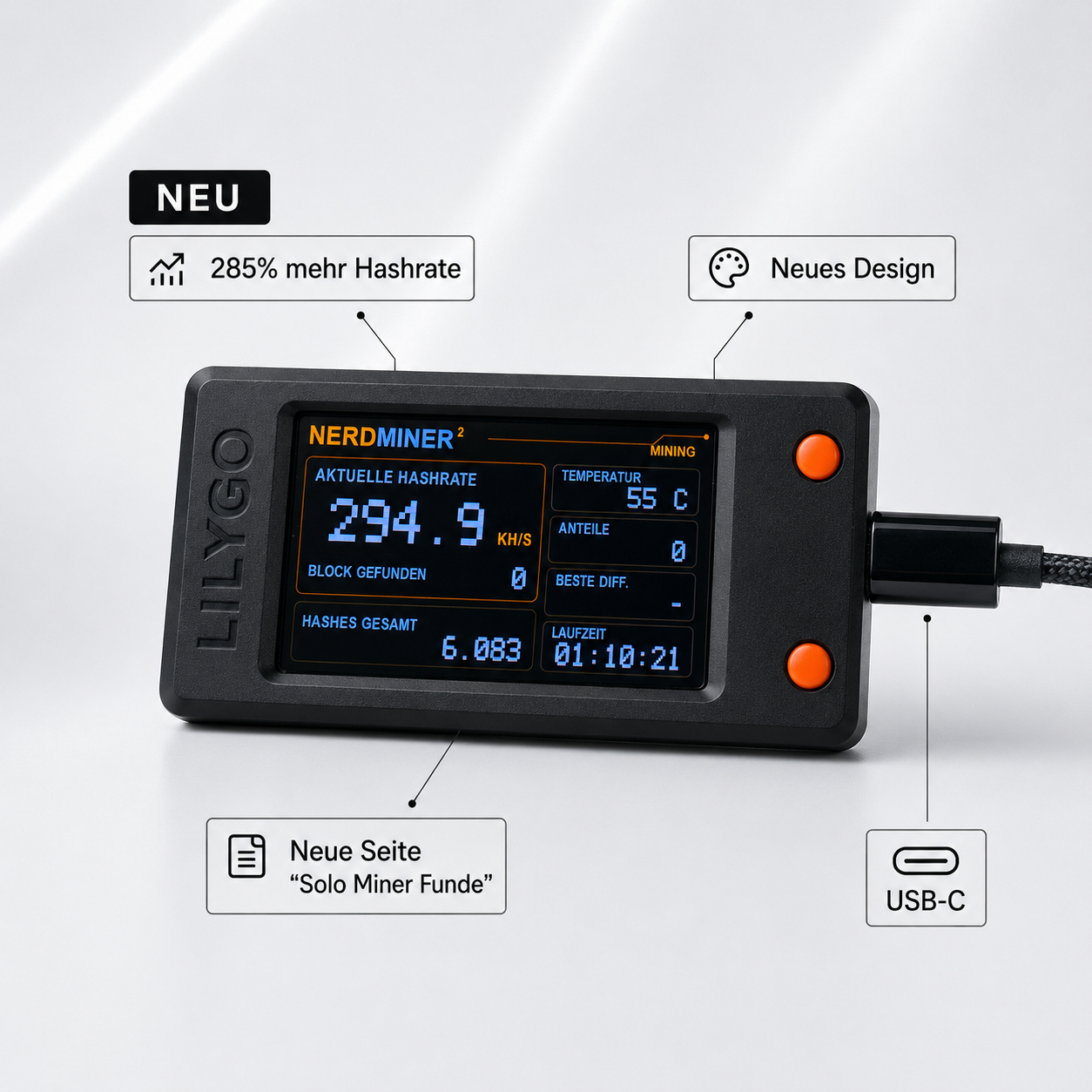
For context: The entire Bitcoin network currently performs around 620 EH/s — meaning 620 quintillion hash attempts per second. A hobby device like the Nerdminer V2 achieves 250 KH/s. A professional Antminer S21 delivers 200 TH/s — that's 800,000 times more than the Nerdminer, yet it still seems like a drop in the ocean compared to the entire network.
A Short History of Bitcoin Mining
Bitcoin mining has gone through four generations of hardware in 16 years:
- CPU Mining (2009-2010): Satoshi and the first Bitcoin pioneers mined with their laptop processors. This worked because the network was still tiny.
- GPU Mining (2010-2013): Resourceful tinkerers discovered that graphics cards could perform parallel calculations much faster than CPUs. A GPU was approximately 100 times faster than a CPU.
- FPGA Mining (2011-2013): Reconfigurable chips (Field Programmable Gate Arrays) were a brief intermediate stage — more efficient than GPUs, but expensive.
- ASIC Mining (2013-today): Application-Specific Integrated Circuits are chips that can do nothing but calculate SHA-256 — but tens of thousands of times faster and more energy-efficient than all predecessors. Since 2013, Bitcoin mining has only been economically viable with ASICs.
Practical consequence: Anyone who wants to mine Bitcoin with a CPU or GPU today is just burning electricity. The only thing that still works with GPUs are other cryptocurrencies with different algorithms — but even there, options are becoming scarce.
Who Mines Bitcoin Today? The Global Mining Landscape
In 2026, Bitcoin mining is a global industrial business with clear geographical hotspots — all sharing one thing: extremely cheap electricity.
- USA (~35-40% of global hashrate): Especially Texas with its deregulated electricity market and surplus wind/solar energy.
- Russia and Kazakhstan (~15%): Subsidized electricity from coal and gas, cold climate for cooling.
- Canada (~7%): Hydropower in Quebec and British Columbia, low electricity prices.
- Paraguay and Latin America (~5%): Itaipú hydroelectric plant produces surplus electricity, which mining utilizes.
- Rest of the world: Scandinavia (hydropower, geothermal), Bhutan (secret state mining operation), Iran (subsidized natural gas).
What connects these locations: Industrial electricity prices are usually below €0.05/kWh — a fraction of what German households pay.
Bitcoin Mining and Energy — Myth and Reality
No topic is as controversial as Bitcoin's energy consumption. The sober figures:
- Bitcoin consumes around 140-160 TWh of electricity annually — comparable to the electricity consumption of a medium-sized country like Poland.
- According to current studies (Cambridge Centre for Alternative Finance), between 52% and 58% of this comes from renewable or CO2-neutral sources — higher than most traditional industries.
- Bitcoin mining increasingly uses "stranded" energy: surplus wind in Texas, methane flaring in oil fields, hydropower peaks in Norway that would otherwise go unused.
The honest assessment: Bitcoin mining consumes a lot of energy, but it is not necessarily environmentally harmful — it depends on the electricity source. Small, hobby devices like a USB solo miner consume less electricity per year than a single smartphone charger.
Mining vs. Staking — The Difference in One Sentence
Bitcoin uses Proof of Work (mining) — security through energy. Other cryptocurrencies like Ethereum use Proof of Stake (staking) — security through staked capital. Both methods have their advantages and disadvantages, but they are not directly comparable: Mining is physically anchored (you need real hardware and real electricity), staking is purely capital-based.
Bitcoin Mining in Germany — Legal, But Rarely Profitable
Bitcoin mining is completely legal in Germany. There are no licenses, no special permits, no BaFin registration for private individuals. You can mine as much as you want — as long as you comply with tax regulations.
Economically, however, mining is a challenge for German hobbyists. With electricity prices of around €0.32/kWh, every watt-hour is expensive. The rule of thumb: As soon as your miner draws more than ~15 watts, electricity consumption becomes the dominant cost factor and mining becomes a subsidy for the electricity provider.
The only exception are extremely power-saving devices under 1 watt — where electricity costs are less than €3 per year. This hobby class does not become a source of income, but serves for learning, fun, and a tiny lottery chance.
Taxes on Mining Profits
If you actually receive Bitcoin through mining, these rules apply in Germany:
- Mining income is other income (§ 22 EStG) with a tax-free limit of €256 per year. Below that, it's tax-free.
- Above that: full personal income tax rate.
- The mined Bitcoin are valued at the current market value at the time of receipt.
- For later sale, the 1-year holding period applies for tax-free disposal (applies to pure hobby mining; not to commercial mining).
Detailed information can be found in our Tax Guide for Bitcoin Mining in Germany. In case of uncertainty, always consult a tax advisor — this page does not replace tax advice.
How Do I Get Started Practically?
If you want not only to understand Bitcoin mining but also to try it out yourself, in 2026 there is only one sensible class of devices for beginners: USB Solo Miners. They cost less than €100, consume less than 1 watt, and participate as full nodes in the Bitcoin network — with all the mathematical opportunities and limitations that entails.
How this technically works, how you can set up a solo miner step-by-step, what your real chances of success are, and which setup pitfalls to avoid, we explain in detail in the Bitcoin Solo Mining Practice Guide — the logical continuation of this article.
Anyone comparing different USB mining devices will find an overview of all relevant models including hashrate, power consumption, and price in the USB Bitcoin Miner Comparison.
Frequent Questions from Bitcoin Mining Beginners
Can I mine Bitcoin with my computer?
Technically yes, economically completely pointless. A modern CPU achieves about 5 MH/s, a strong GPU perhaps 1 GH/s. The entire Bitcoin network performs 620 EH/s — your share would be computationally 0. In addition, there's the power consumption of 200-500 watts, which exceeds any theoretical reward by factors.
What is the difference between mining and simply buying Bitcoin?
When you buy, you get Bitcoin directly at market price, without hardware investment or power consumption. Mining is the only way to create new Bitcoin, and at the same time the mechanism that secures the network. Economically, buying is more sensible for most private individuals; mining makes sense for learning, hobby, and lottery reasons.
When should I stop mining?
As soon as your monthly electricity costs exceed the value of the generated Bitcoin — and this happens practically immediately for large miners in Germany. For mini-devices under 1 watt, the question is irrelevant: The electricity costs are so low that you can play for years without loss.
What is the Bitcoin Halving and why does it affect mining?
Every 210,000 blocks (approximately every 4 years), the block reward halves. In 2024, it decreased from 6.25 to 3.125 BTC. The next halving will occur in 2028 — then to 1.5625 BTC. Mining becomes more challenging with each halving because the reward decreases while costs remain the same. In the long term, new blocks will only be compensated by transaction fees instead of reward Bitcoin.
Is mining the same as solving complicated math problems?
No — a widespread misconception. Mining is not a mathematical feat, but pure brute-force guessing. The task is mathematically trivial (calculating a hash), but finding the correct solution is only possible through trial and error. So, mining rewards raw computing speed, not cleverness.
Further Reading — Relevant Deep Dives
- Bitcoin Solo Mining 2026 — Practical Guide and Calculated Chances of Success — the direct continuation of this article
- USB Bitcoin Miner Comparison — All Relevant Models 2026
- How Much Power Does a USB Miner Really Consume?
- Bitcoin Mining Taxes in Germany 2026
- Nerdminer V2 vs. BitAxe — The Detailed Comparison


Teilen: