Short answer
What is the bitcoin halving, in one sentence?
Roughly every four years (precisely: every 210,000 blocks) the block reward miners receive is cut in half. It currently stands at 3.125 BTC and the next halving is expected around 2028. For professional miners it is a cost shock; for small miners like the Nerdminer V2 or the NerdNOS it barely matters. Every halving so far has been followed by a rising price, which is emphatically not a guarantee that the next one will be.
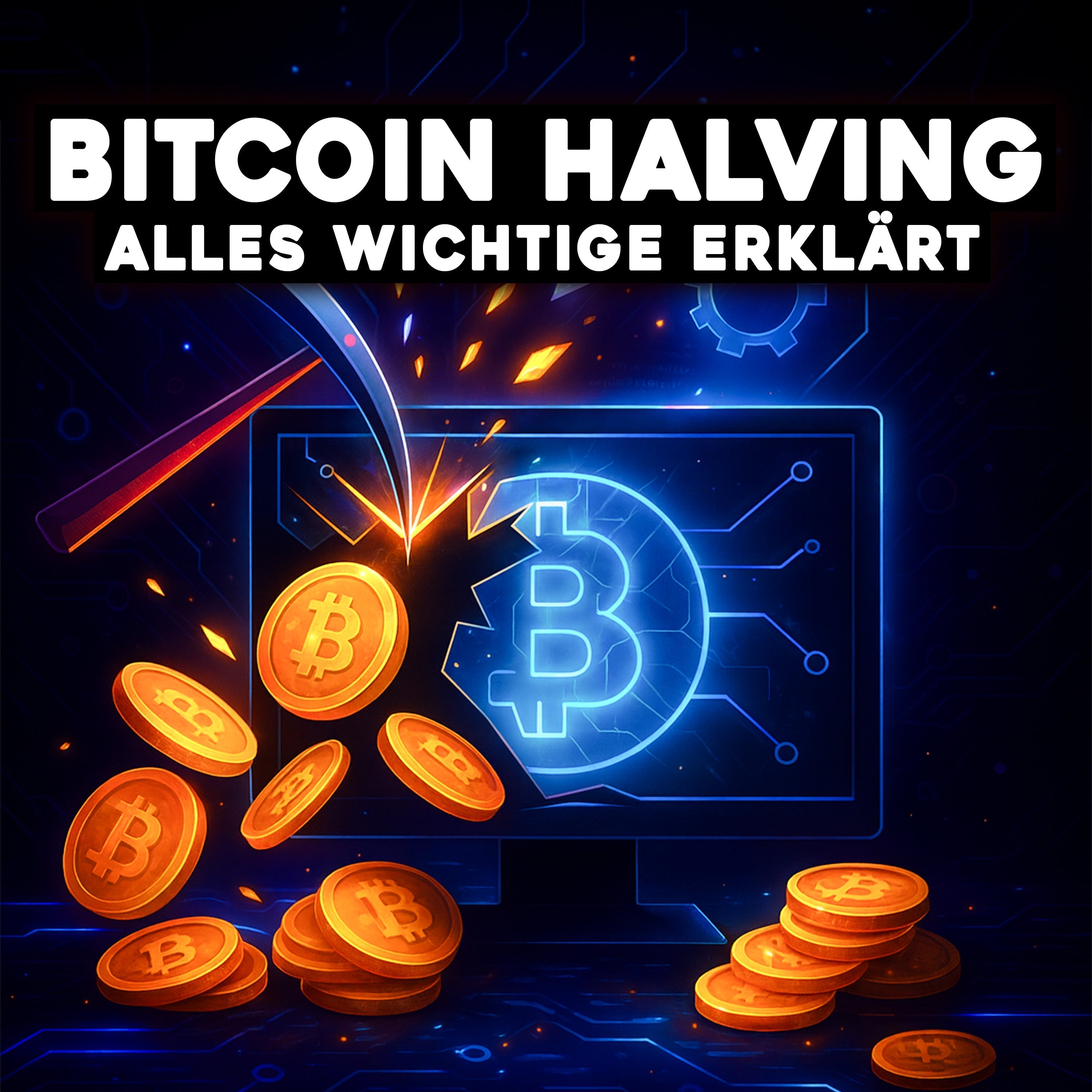
Every 210,000 blocks, about once every four years, the reward bitcoin miners receive for finding a block is halved. The event is called the bitcoin halving and it is one of the most important mechanisms in the bitcoin protocol. It governs how many new bitcoin come into existence each day, how profitable mining is, and, if you believe the historical pattern, how the bitcoin price develops over the following 12 to 18 months.
The halving timeline: every event so far and the ones ahead
| Halving no. | Date | Block reward before | Block reward after | BTC/day (after) |
|---|---|---|---|---|
| — | 3 Jan 2009 (genesis) | — | 50 BTC | 7,200 |
| 1 | 28 Nov 2012 | 50 BTC | 25 BTC | 3,600 |
| 2 | 9 Jul 2016 | 25 BTC | 12.5 BTC | 1,800 |
| 3 | 11 May 2020 | 12.5 BTC | 6.25 BTC | 900 |
| 4 | 20 Apr 2024 | 6.25 BTC | 3.125 BTC | 450 |
| 5 (next) | ~2028 | 3.125 BTC | 1.5625 BTC | 225 |
| 6 | ~2032 | 1.5625 BTC | 0.78125 BTC | 112.5 |
| Final halving | ~2140 | 1 satoshi | 0 (no reward) | 0 |
As of 2026 we are in the fourth halving cycle. Miners receive 3.125 BTC per block. About 450 new bitcoin are created every day, which is 0.0021 % of the maximum supply of 21 million coins.
Why does the halving exist?
Satoshi Nakamoto built the halving into the bitcoin protocol for two reasons:
-
Controlled inflation. Without the halving all 21 million bitcoin would have been mined in roughly 8 years. With it, issuance slows logarithmically: by 2026
19.6of 21 million bitcoin have been mined, but the final 1.4 million are spread across more than a century. - A long-term supply shock. Each halving cuts the daily new supply of bitcoin in half. If demand stays level or grows, simple economics says the price should rise. That has held after every halving so far, though correlation is not causation.
What does the halving mean for miners?
For professional miners every halving is a cost shock. Revenue halves overnight while the electricity bill stays exactly where it was. The consequences:
- Inefficient miners get switched off. Older hardware (an Antminer S9 at 100 J/TH, say) becomes uneconomic after a halving. Only the newest, most efficient ASICs (an Antminer S21 at 17.5 J/TH) stay in the race.
- Network hash rate dips short term. In the 2 to 4 weeks after a halving the global hash rate typically falls by 5 to 15 % as unprofitable miners power down.
- Difficulty adjusts. After 2016 blocks, roughly two weeks, the network lowers difficulty, which makes the remaining miners profitable again.
-
The break-even electricity price moves. After the 2024 halving, break-even for an Antminer S21 sits at around
€0.07-0.08/kWhinstead of the earlier€0.14-0.16/kWh. German household electricity prices are far above that line.
What does the halving mean for hobby miners?
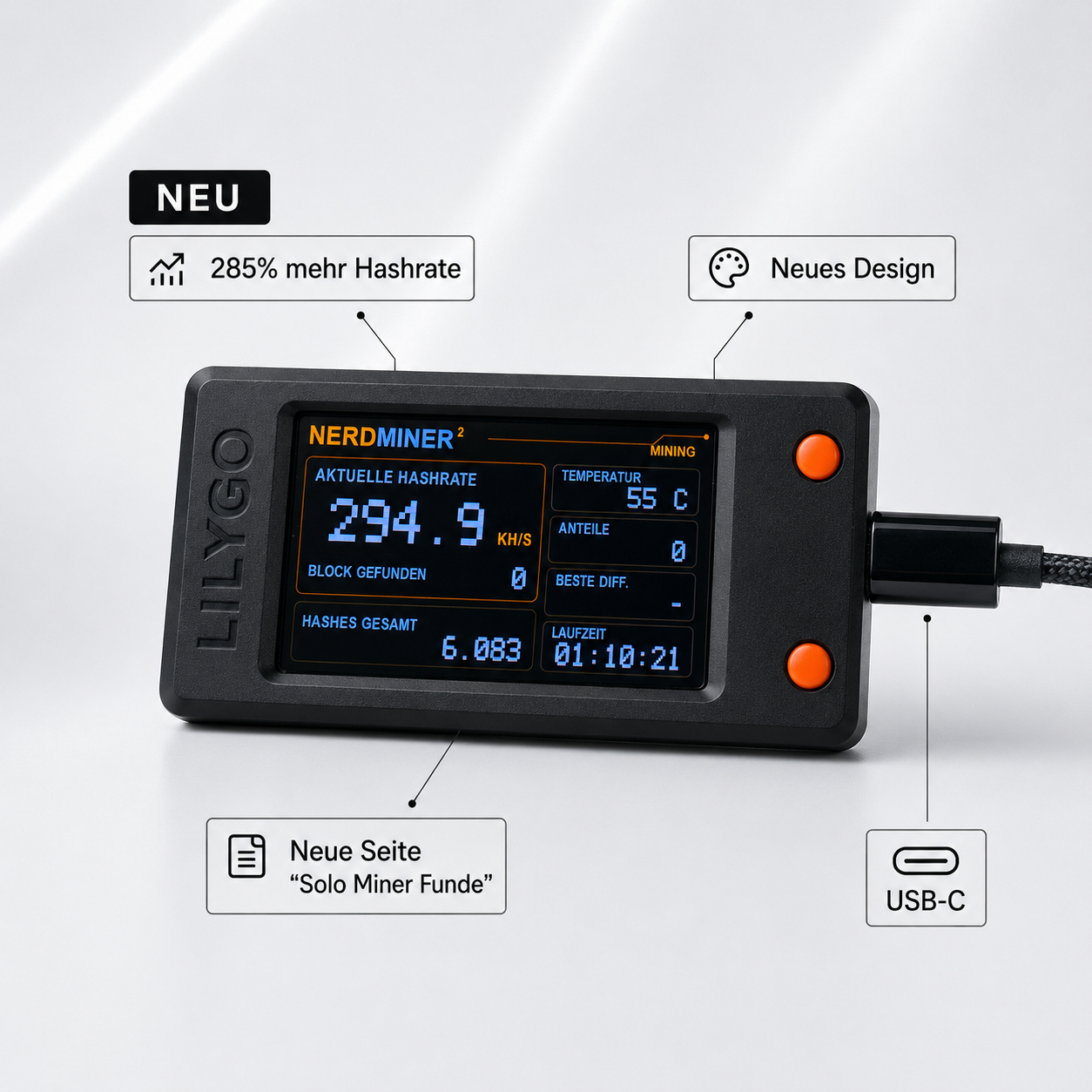
For Nerdminer V2 owners and other small miners essentially nothing changes. The Nerdminer V2 is a learning device and a lottery ticket before and after the halving alike. Its tiny electricity cost does not move, and in the unlikely event of a find, the whole block is still yours. The one difference: if you do find a block you now receive 3.125 BTC rather than 6.25 BTC. At the current price that is still about €195,000 (3.125 BTC × ~€63,000), far more than enough to cover the roughly €50 the device costs.
If you want to take it a little more seriously, the NerdNOS is a real ASIC at ~100 GH/s drawing only 7-8 W. It is equally unaffected, because its running cost is so small that the arithmetic simply does not change. Hobby mining survives every halving without trouble, whether you run a V2 as a learning device or a NerdNOS as a small ASIC upgrade.
Hold bitcoin directly, or be ready to receive a block find
If you would rather hold bitcoin directly (or need somewhere to receive a block find): a bitcoin address of your own is free and takes under 10 minutes at Finst, which is EU regulated.
Create a bitcoin address at Finst →The halving and the bitcoin price, a look at the record
In each of the three completed halving cycles the bitcoin price reached a new all-time high within 12 to 18 months of the halving:
-
2012 halving: price at the halving
~$12→ all-time high ~$1,000 (Nov 2013). Factor: ~83× -
2016 halving: price at the halving
~$650→ all-time high ~$19,500 (Dec 2017). Factor: ~30× -
2020 halving: price at the halving
~$8,500→ all-time high ~$69,000 (Nov 2021). Factor: ~8× -
2024 halving: price at the halving
~$63,000→ [current cycle, still open]
How to read this: the historical correlation is striking, but the factor shrinks with every cycle. Whether the pattern repeats in 2024 to 2026 is an open question. Past performance guarantees nothing. The halving is a supply shock; whether it shows up in the price depends on demand, regulation, the wider economy and market sentiment. Correlation is not causation.
What happens after the last halving?
Around the year 2140 the last new bitcoin will be mined. From then on miners receive no block reward at all, only transaction fees. The central question: are transaction fees alone enough to pay for a secure mining network?
The bitcoin community is split. Optimists argue that as usage grows, fees per block rise to a sufficient level. Sceptics worry that without the reward subsidy the network hash rate falls and security suffers.
Realistically: that is a question for 2140, which is a good 114 years away. Thirty-one further halvings happen between now and then, and the community has more than a century to work out an answer.
Common questions about the bitcoin halving
When is the next bitcoin halving?
Expected in 2028 (block 1,050,000). The exact date depends on how fast blocks are produced and is only pinned down 1 to 2 months in advance.
Does the bitcoin price always rise after a halving?
Historically yes, after all three completed halvings. But three data points are not a statistically sound pattern. There is no guarantee that the 2024 halving plays out the same way.
Should I buy my Nerdminer V2 before the halving?
The halving changes nothing about the Nerdminer V2 itself; it works exactly as it did before. The one difference is that the potential block reward is smaller. Since the appeal lies in the lottery and in what you learn, the timing of the purchase hardly matters.
Which miners survive a halving?
Only the most efficient ones. After the 2024 halving, anything above 30 J/TH is uneconomic at normal electricity prices. Only the Antminer S19 XP and newer (below 22 J/TH) stay viable long term. Small miners like the Nerdminer V2 and the NerdNOS are unaffected, because their electricity cost is negligible either way.
What is the "stock-to-flow" thesis and does it relate to the halving?
Stock-to-flow (S2F) is a valuation model by the analyst PlanB that projects the bitcoin price from its scarcity, meaning supply divided by annual production. The halving halves annual production and therefore doubles the S2F ratio. The model explained the 2012 to 2020 halvings well but drew heavy criticism in 2022 and 2023 for price forecasts that did not hold. It is an interesting framework, not a crystal ball.
Read on
Start mining, untouched by the halving
The halving hits professional farms, not the socket at home. The Nerdminer V2 is the affordable learning device and lottery ticket, the NerdNOS the real mini ASIC at ~100 GH/s. Tiny running costs leave both of them untouched by the halving.


Share: