Short answer
Solo against pool is pure maths, and your hash rate decides it
Below 1 TH/s (Nerdminer V2, NerdNOS, BitAxe) solo is the right mode: a real if small chance at the WHOLE block instead of fractions of a cent. Mid-sized hobby setups up to about 500 TH/s belong in a pool, for predictable cash flow. Only large farms from 1 PH/s go solo again, because the saved pool fees then add up to real money.
The choice between solo mining and pool mining is not ideology, it is arithmetic, and the right mode depends solely on your hash rate. With a Nerdminer V2 (250 KH/s) or a BitAxe (1 TH/s) the answer is clearly different from an Antminer S21 (200 TH/s). This article lays out the bare numbers, explains statistical variance and gives you a decision table that settles the question in two minutes.
What are solo and pool mining?
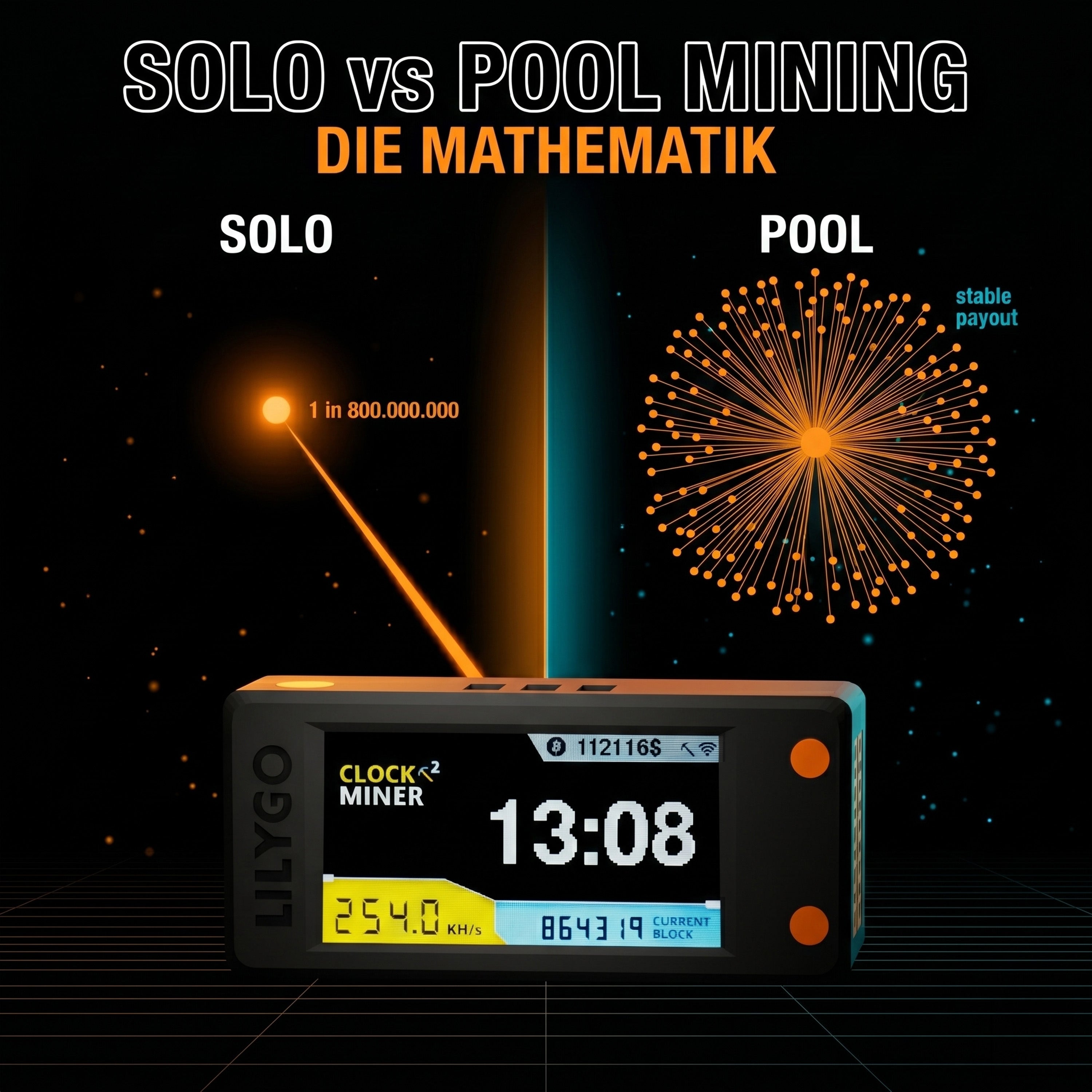
Solo mining: you try on your own to find a bitcoin block. If you succeed, the entire block reward of 3.125 BTC (around €195,000 at the current price) is yours, less any solo pool fee of 0 to 2 %.
Pool mining: you join a mining pool that bundles the hash rates of thousands of miners. When any member of the pool finds a block, the reward is shared out in proportion to the hash rate each contributed. You get regular small payments instead of a lottery.
Technically the two modes are nearly identical: you connect your device to a pool URL over the stratum protocol. The only difference is whether that pool is a "solo pool" (keeps the whole reward for you) or a classic pool (shares the reward out).
The core equation: hash rate decides
The decision comes down to a single question: how often can you realistically find a block per year?
| Hash rate | Expected blocks/year | Statistical variance | Recommended mode |
|---|---|---|---|
| 250 KH/s (Nerdminer V2) | 0.000021 | extremely high | Solo, a pure lottery |
| ~100 GH/s (NerdNOS) | 0.0084 | extremely high | Solo, a lottery with more tickets |
| 1 TH/s (BitAxe Gamma) | 0.082 | very high | Solo, a deliberate lottery |
| 10 TH/s (small farm) | 0.82 | high | Pool, for cash flow |
| 100 TH/s (one S19) | 8.2 | moderate | Pool, steady income |
| 1 PH/s (mid-sized farm) | 82 | low | Solo pays off again |
| 100 PH/s (industrial) | 8,200 | minimal | Solo, to maximise the reward |
Why variance matters
With a Nerdminer V2 expecting 0.000021 blocks a year you could in theory get lucky and find a block in month 3, or go many years without one. Both are entirely possible statistically, because mining is a Poisson-distributed lottery. The waiting time is pure luck, and that lottery is precisely the appeal. The "expected waiting time" is only the average across all possible worlds.
The higher the hash rate, the smaller that variance. A miner with 10,000 TH/s (10 petahash, a mid-sized farm) would statistically find 820 blocks a year. The variance is small enough that solo and pool returns converge, except that in solo mining all 820 block rewards are yours rather than shared.
The three-band decision
The maths produces three clear bands:
Band 1: below 1 TH/s, solo is the only sensible choice
Hash rates like the Nerdminer V2 (250 KH/s), the NerdNOS (~100 GH/s), a BitAxe Gamma (1 TH/s) or an older GekkoScience USB setup fall into this class. Pool shares at that hash rate would be vanishingly small. A worked example:
- Nerdminer V2 at 250 KH/s in a pool charging 1 %
- Network hash rate: 620 EH/s
- Your share: 250,000 / 620,000,000,000,000,000,000 = 4 × 10⁻¹⁶
- Daily pool payout: 450 BTC × 4 × 10⁻¹⁶ = 1.8 × 10⁻¹³ BTC
- In euros: a tiny fraction of a cent per day
That is why solo is the right mode for the Nerdminer V2 and the NerdNOS: pool shares at this hash rate would be vanishingly small, while solo gives you the real if small chance at the WHOLE block (3.125 BTC, around €195,000). That full jackpot instead of fractions of a cent is the appeal. More hash rate simply means more tickets in the same game: at ~100 GH/s the NerdNOS puts roughly 400,000 times the V2's hash rate on the table. The chance stays small, but it is noticeably larger than the V2's.
Band 2: 1 to 500 TH/s, pool mining for cash flow
This is where serious hobby and prosumer miners operate, from a 100 TH/s Antminer S19 through several machines in parallel to small farms with 5 to 10 professional ASICs. Here pool mining makes clear mathematical sense:
- Expected blocks per year: between 0.08 and 41
- Variance is high; you might find 2 blocks in one year or none in five
- Pool mining gives you a steady cash flow instead, which covers your electricity directly
- Pool fees of 1 to 3 % are the price of that stability
A worked example at 100 TH/s (one Antminer S19):
- Share of the network: 100 / 620,000,000 = 1.6 × 10⁻⁷
- Expected BTC per day: 450 × 1.6 × 10⁻⁷ = 0.0000726 BTC
- In euros: ~€4.35 a day gross
- Less 1 % pool fee: ~€4.31
- Electricity at 3,100 W and €0.32/kWh: ~€23.80 a day
- Net result: around -€19.50 a day on German household electricity
In this example the return does not cover the electricity on German household rates, which is the typical home case with a power-hungry professional ASIC. Pool mining at least makes the outcome predictable. That is exactly why the small-miner approach is the more relaxed route at home: a small outlay, silent, the lottery thrill without an electricity deficit. A Nerdminer V2 or NerdNOS draws so little that the electricity bill stays in the cents, and the block chance is real all the same.
Band 3: above 1 PH/s, solo mining makes sense again
Large mining farms with 1,000+ TH/s (1 PH/s) reach a statistical certainty at which solo mining makes sense again. Variance shrinks to an acceptable level, and the 1 to 2 % of pool fees saved becomes real money at those absolute numbers:
- A 1 PH/s farm expects roughly 82 blocks a year
- 82 × 3.125 BTC × 1 % pool fee = ~2.5 BTC of fees saved a year
- In euros: ~€150,000 a year purely from running solo instead of in a pool
That explains why large industrial farms often mine solo again: at enormous hash rates the fee saving adds up to significant sums, and the variance becomes manageable at that size.
The best solo pools for hobby miners
If you want to mine solo with a Nerdminer V2, a NerdNOS, a BitAxe or a similar device, you normally connect to what is called a solo pool. The main options in 2026:
-
public-pool.io — 0 % fee, free, community run, stratum:
public-pool.io:21496 -
solo.ckpool.org — 2 % fee, the oldest solo pool, extremely stable, stratum:
solo.ckpool.org:3333 - solomining.io — 1 % fee, web dashboard included
The factory default for the Nerdminer V2 and the NerdNOS is public-pool.io. You do not have to change anything. Details: the bitcoin solo mining practice guide and setting up the NerdNOS.
Solo mining needs an address of your own
For solo mining you need your own bc1q address, because that is where the whole block goes if you get lucky. Free and under 10 minutes at Finst, with no hardware wallet needed to start.
The best classic pools for professional miners
If you want to pool mine with an Antminer or similar professional hardware:
- Foundry USA — the largest pool worldwide (~30 % of network hash rate)
- Antpool (by Bitmain) — straight from the hardware manufacturer
- F2Pool — running since 2013, large community
- ViaBTC — good rewards, stable servers
- Braiins Pool (formerly Slush Pool) — the first bitcoin pool, very transparent
All the large pools charge 1 to 3 % and pay out regularly. Choosing between them is mostly personal preference; the performance differences are in the low single-digit percentages.
When to switch modes
Mining modes are not permanent. You can switch between solo and pool at any time by entering a different stratum URL. Typical reasons to switch:
- Solo to pool: when you move from a Nerdminer V2 to a BitAxe Supra (8 TH/s) or a used Antminer S17 (50 TH/s), pool mining suddenly becomes the more economic option.
- Pool to solo: at very large setups above 1 PH/s, or as a deliberate lottery decision at mid-range hash rates (the chance at a complete block).
- Hybrid: some setups split the hash rate: 80 % to a pool for steady cash flow, 20 % to a solo pool for the lottery chance.
Common questions about solo against pool mining
Can I even pool mine with a Nerdminer V2?
Technically yes, you can enter any stratum URL, including a classic pool's. In practice the shares would be so small that they usually stay below the pool's minimum payout. Solo is therefore the sensible configuration: the real chance at the whole block.
Am I missing out on "real" bitcoin by mining solo instead of in a pool?
At very low hash rates (Nerdminer V2, NerdNOS) practically not. Solo is your realistic payout path here, because pool shares would be vanishingly small. Only from 10 TH/s upwards do regular pool rewards add up to meaningful amounts that you forgo in solo mode.
Are there bitcoin pools that explicitly accept solo miners with tiny hash rates?
Yes. public-pool.io and solo.ckpool.org expressly accept USB solo miners. They are built for hobby hash rates in the KH/s and GH/s range.
Do I have to change anything on the Nerdminer for solo mining?
No. The Nerdminer V2 ships configured for solo mining via public-pool.io. You only enter your own bitcoin address (bc1q…) and the rest runs by itself.
Which mode is fairer to the bitcoin network?
Both are technically identical and equally within the rules. Solo mining is slightly more decentralised (no dependence on a handful of large pools), but for private miners the variance makes it mostly a lottery. Pool mining centralises part of the mining power with pool operators, but for power-hungry professional hardware it is the economically predictable route.
Conclusion
The solo against pool decision is not a matter of philosophy, it is a calculation. On small miners below 1 TH/s, solo is the sensible choice (and usually the default): a real chance at the whole block rather than fractions of a cent. On mid-sized and large hobby setups up to 500 TH/s, pool mining produces predictable cash flow. On industrial farms above 1 PH/s, solo becomes attractive again. If you are unsure, stay with your device's default configuration; for the Nerdminer V2, the NerdNOS, the BitAxe and most hobby miners that is solo via public-pool.io.
Read on
Ready for your own block lottery?
Silent, frugal, configured for solo out of the box: pick the device that matches your budget, the V2 as the cheapest way in, the NerdNOS with far more tickets in the same game.
See the Nerdminer V2 → See the NerdNOS → Both devices: solo ready, ~1 W and 7-8 W respectively, no contract.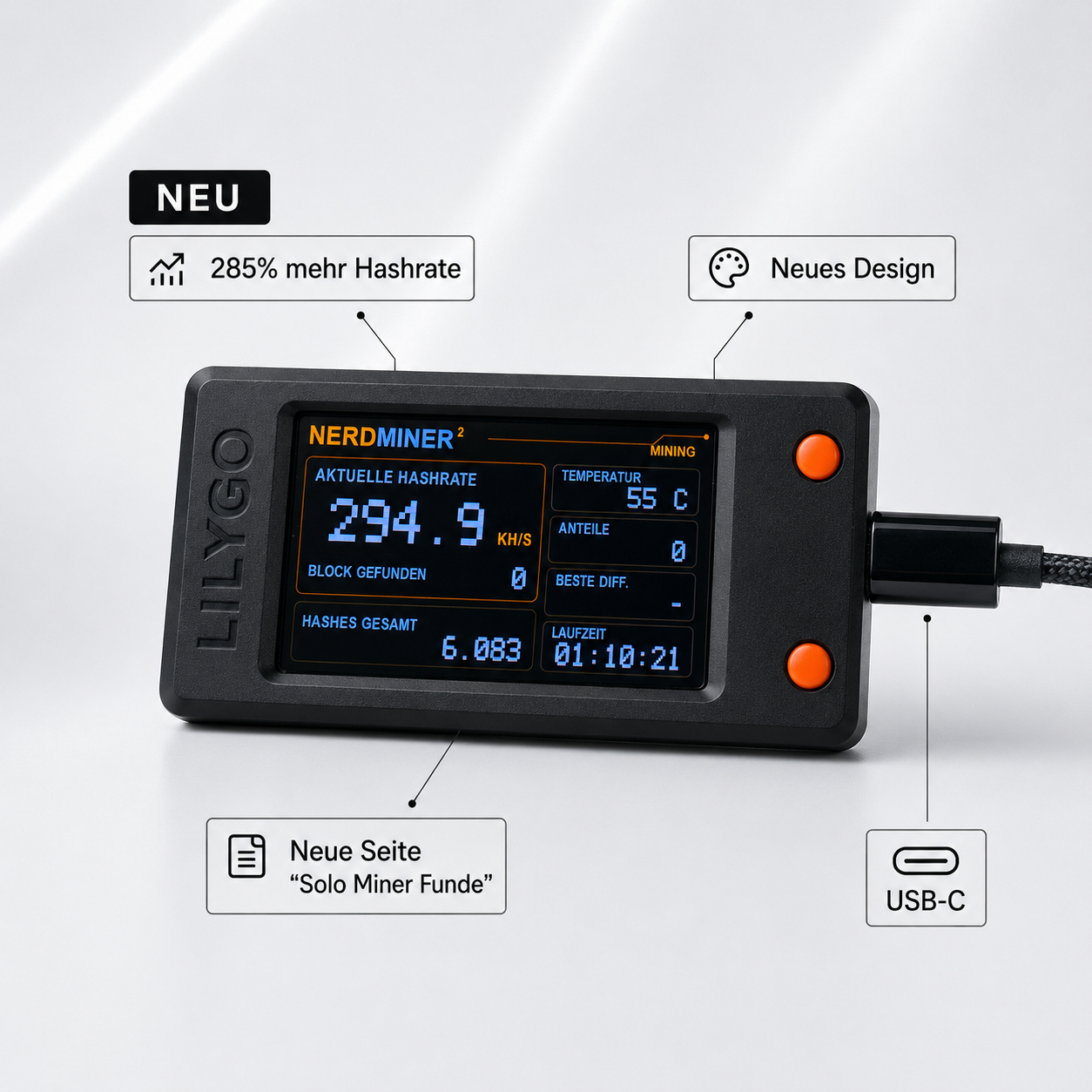


Share: