Crypto Mining 2026 — What the Term Means and What's Behind It
"Krypto schürfen" is the German equivalent of "crypto mining" — and the imagery has remained: it sounds like gold prospecting, claims, and adventure. But behind it lies not a pickaxe, but a highly technical process that keeps the Bitcoin and other crypto networks running. This article explains what "crypto mining" means in everyday life, where the term comes from, which cryptocurrencies can still be mined today, and what German hobby miners need to consider legally.
Where does the term "Mining" come from?
Satoshi Nakamoto, the inventor of Bitcoin, deliberately chose the metaphor of mining in 2008. In his whitepaper, he described how new Bitcoins are "created" through computationally intensive work – similar to gold prospectors finding gold nuggets in a river. The German translation "Schürfen" (mining) has become particularly established as an everyday term in German-speaking countries and now appears in news, financial administration, and colloquial language.
The comparison to gold mining holds true in one important aspect: there is a limited supply. For gold, the Earth's crust is the limit; for Bitcoin, it's 21 million coins – according to Satoshi's plan. Each mined Bitcoin brings us closer to this limit, and every 4 years, the amount of newly generated coins from "mining" is halved (the so-called Halving). In 2024, the block reward dropped from 6.25 to 3.125 BTC; in 2028, it will fall to 1.5625 BTC.
How does "Crypto Mining" work technically?
The romantic term "mining" describes a sober process: microprocessors (or specialized ASIC chips) solve mathematical problems until they find a solution that meets certain conditions. Whoever finds the solution first is allowed to append the next block to the blockchain and receives the mining reward – newly generated coins plus transaction fees.
For Bitcoin, this algorithm is called SHA-256; for other coins, there are different methods (Scrypt for Litecoin, kHeavyHash for Kaspa, RandomX for Monero). The basic mechanism remains the same: calculate until a hit, a hit brings a reward. A detailed explanation of the basics can be found in the Bitcoin Mining Beginner's Guide.
Which cryptocurrencies can be mined?
Not all cryptocurrencies can be mined. Since Ethereum switched to Proof-of-Stake in 2022, the distinction has become clearer. Overview 2026:
| Cryptocurrency | Minable? | Algorithm | Special Feature |
|---|---|---|---|
| Bitcoin (BTC) | ✓ Yes | SHA-256 | ASIC-dominated, industry standard |
| Bitcoin Cash (BCH) | ✓ Yes | SHA-256 | Merge mining with BTC possible |
| Litecoin (LTC) | ✓ Yes | Scrypt | Merge mining with Dogecoin |
| Dogecoin (DOGE) | ✓ Yes | Scrypt | Runs in parallel with Litecoin |
| Monero (XMR) | ✓ Yes | RandomX | CPU-friendly, ASIC-resistant |
| Kaspa (KAS) | ✓ Yes | kHeavyHash | Young BlockDAG system |
| Alephium (ALPH) | ✓ Yes | Blake3 | Proof-of-Less-Work Hybrid |
| Ravencoin (RVN) | ✓ Yes | Kawpow | GPU standard |
| Ergo (ERG) | ✓ Yes | Autolykos v2 | ASIC-resistant |
| Ethereum (ETH) | ✗ No | Proof of Stake | No more mining since 2022 |
| Solana (SOL) | ✗ No | Proof of History + Stake | Never designed as PoW |
| Cardano (ADA) | ✗ No | Proof of Stake | Ouroboros Consensus |
The largest "minable" coins are and remain Bitcoin and the Bitcoin forks. Everything else is a niche with smaller communities and fluctuating returns.
Can you legally mine crypto in Germany?
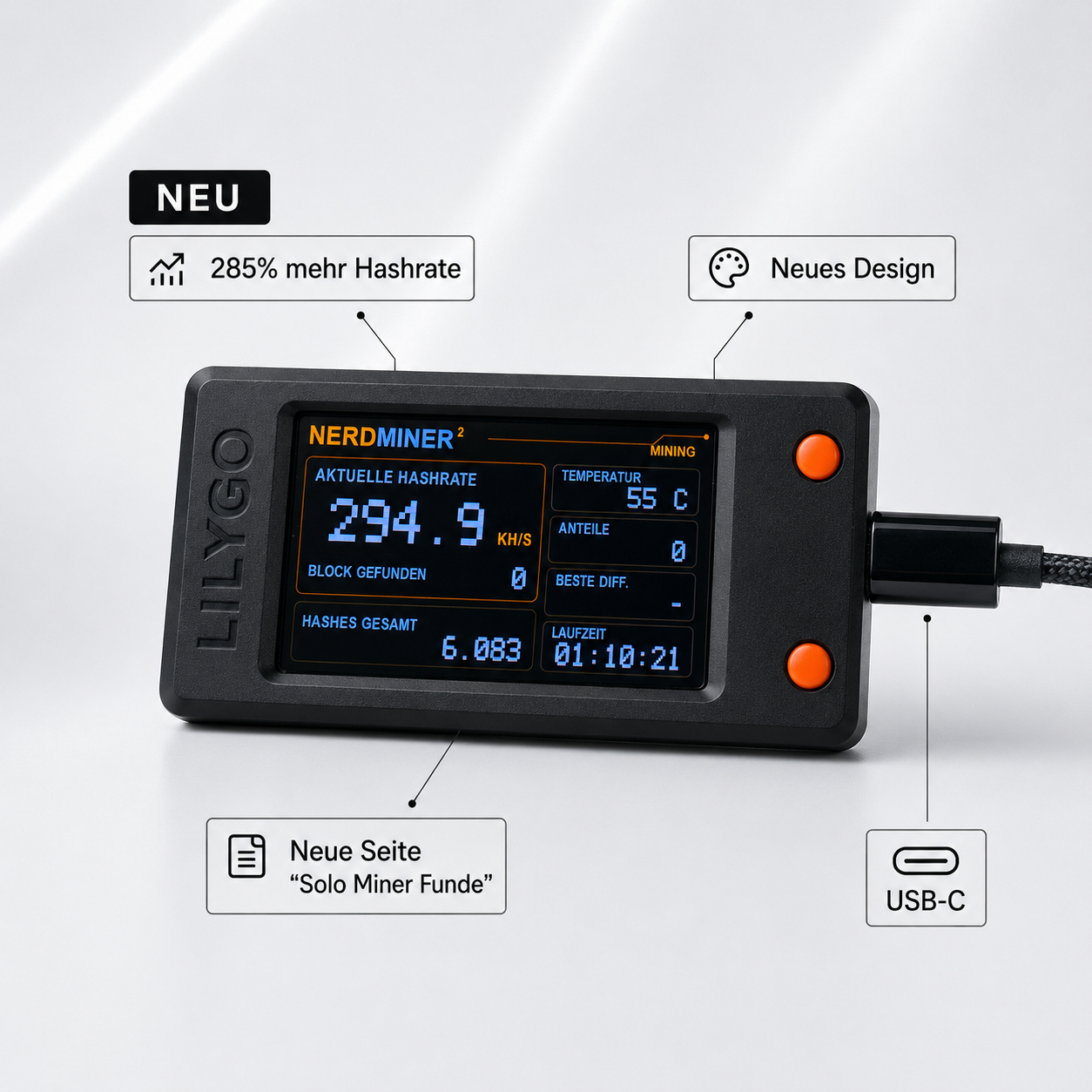
Yes, completely legal. There is no special permit, no registration, no restriction for private individuals. As long as you pay for the electricity (theft or illegal connection would be punishable), you can mine 24/7 — whether with a Nerdminer V2 for €50 or with an industrial machine for €5,000.
However, tax obligations are important. According to German case law (BFH, judgment of 14.02.2023), mining income is considered other income according to § 22 No. 3 EStG. The most important points:
- Tax-free allowance of €256 per year — below this amount, it is tax-free
- Above €256: fully taxable at your personal income tax rate
- Valuation at the time of receipt: Mined coins are valued at the daily rate upon receipt
- Subsequent sale: For private mining, the 1-year holding period applies for tax-free profits from sales
- Commercial mining: In the case of systematic, economically oriented operations, tax authorities may classify it as a commercial activity — then commercial tax law applies and no 1-year period
In practice, hobby mining with a Nerdminer V2 is tax-irrelevant because the expected returns are far below the €256 tax-free allowance. Detailed information: Bitcoin Mining Taxes in Germany 2026.
Crypto Mining at Home — What's Really Possible?
A common misconception: "Crypto mining" automatically means printing money at home. The reality is more complicated. In Germany, where household electricity costs around €0.32/kWh, profitability depends entirely on the hardware.
- Mini-miners (Nerdminer V2, GekkoScience): Electricity costs under €5 per year, mining yields practically zero — purely a learning and hobby project
- Open-source boards (BitAxe): Electricity costs €35-45 per year, mining yields in the same range — roughly break-even
- Professional ASICs (Antminer, Whatsminer): Electricity costs €8,000-12,000 per year, unprofitable in Germany — only worthwhile with industrial electricity < €0.08/kWh
Realistically, "crypto mining at home" in Germany in 2026 is a hobby for most people, not an income. If you want to change that, you either have to emigrate to Paraguay or Texas, or operate your own PV system with surplus feed-in. Details: Bitcoin Mining for Home — realistically possible or a money pit?
The Alternative to Mining: Buying and Holding
Anyone who seriously wants to own Bitcoin or other cryptocurrencies will almost always achieve their goal more cheaply by direct purchase on an exchange than by mining. Example calculation:
- You invest €500 in a Nerdminer V2 plus electricity for 10 years (~€28)
- Over 10 years, the Nerdminer will, on average, produce around 0.0002 BTC (statistically, without a block fund)
- Or: You buy Bitcoin directly for €500 → at the current exchange rate, you get around 0.0083 BTC
Direct purchase delivers 40 times more Bitcoin than mining with a Nerdminer. Mining is only worthwhile if you value the learning and experience aspect – or if you are banking on the "lottery win" of a block fund.
Frequently Asked Questions about Crypto Mining
What is the difference between "Schürfen" (mining) and "Mining"?
No difference. "Schürfen" is the German word, "Mining" is the English word. Both describe the same process: creating new cryptocurrency units through computational work.
Can I mine cryptocurrencies with my PC?
Technically yes, but pointless for Bitcoin (a PC is billions of times too slow). For CPU-friendly altcoins like Monero, it works with a modern AMD Ryzen CPU, or for GPU-friendly coins like Ravencoin with an Nvidia RTX 4070 or higher. Detailed comparison: Crypto Miner Comparison for Altcoins.
How much electricity does crypto mining require?
That depends entirely on the hardware. A Nerdminer V2 uses less than 1 watt, an Antminer S21 uses 3,500 watts – 3,500 times more. A medium-sized mining farm with 20 devices consumes more electricity than an entire German apartment building.
Is mining harmful to the environment?
That depends on the power source. Currently, about 52-58% of the world's Bitcoin mining energy comes from renewable or carbon-neutral sources (according to the Cambridge Bitcoin Electricity Consumption Index). Hobby mining with a mini-miner under 1 watt has a negligible CO2 footprint – less than charging a smartphone daily.
What hardware is best to start with?
For hobby miners with a desire to learn: the Nerdminer V2 (€48.99). For tech enthusiasts with a larger budget: a BitAxe Gamma (€150-200). For serious profitability: a professional mining farm with industrial electricity – not feasible at home.


Teilen: